If you searched for “openclaw game,” you landed on a name collision. There are two active open-source projects called OpenClaw and they are unrelated: one is a C++ reimplementation of the 1997 Monolith platformer Captain Claw, the other is an AI agent framework with 160,000+ GitHub stars. This article routes you to whichever one you actually wanted, with enough detail on both that you can recognize the difference in future searches.
We maintain the largest body of editorial content on the OpenClaw AI framework, so we have a direct interest in keeping this disambiguation honest. We will not oversell the game project to capture its search traffic, and we will not pretend the framework and the game are related.
Quick Router: Which OpenClaw Did You Mean?
Answer one question: do you want to play a 2D platformer or run an AI agent?
- Play a cat-pirate platformer from 1997. You want the game. Go to github.com/pjasicek/OpenClaw. The rest of this article’s first half is for you.
- Run a personal AI agent on a VPS, Telegram, or your laptop. You want the framework. Read our OpenClaw AI agent framework overview or the installation guide. The second half of this article explains what it is.
- You are not sure which you meant. Keep reading. The first difference that will clarify things: the game project requires the original 1997
CLAW.REZdata file to run. The AI framework requires an LLM API key (OpenAI, Anthropic, or similar). If you already own Captain Claw, the game is what you want. If you already have an OpenAI account, the framework is what you want.
OpenClaw the Game: Captain Claw 1997, Rebuilt
What It Actually Is
OpenClaw is a community project that rebuilds the engine of Captain Claw, a 2D side-scrolling platformer Monolith Productions released in 1997. The player controls Nathaniel J. Claw, a cat pirate, and fights through cartoon-style levels in search of amulet gems. The original game runs on Windows 95/98 era binaries and does not work reliably on modern operating systems without significant compatibility gymnastics.
The OpenClaw project replaces that legacy engine with a modern, cross-platform rewrite in C++. It is not an emulator. Emulators mimic old hardware; OpenClaw reimplements the game’s logic from scratch and reads the original game’s data files (sprites, music, level definitions) so modern operating systems can render them natively. Think of it as a new cartridge reader for an old game, not a virtual machine running the old machine.
The canonical repository is pjasicek/OpenClaw, with several active forks (including gmh5225/Game-OpenClaw and mialy/OpenClaw) and adjacent community ports such as ClawSwitch for the Nintendo Switch.
Be calibrated about scale. This is a respected fan project, not a mass-market product. The main repository sits in the low hundreds of GitHub stars, which is healthy for a retro-gaming rewrite but nowhere near the size of the AI agent project that shares its name. Anyone claiming OpenClaw the game has hundreds of thousands of stars is either confused about the project or collapsing the two OpenClaws into one.
Tech Stack and License
The engine is written in C++ and built around a small set of mature libraries:
- SDL2 (including SDL_Image, SDL_TTF, SDL_Mixer, SDL2_Gfx) for graphics, input, fonts, and audio.
- Box2D for physics. Pit traps, momentum, and collision handling run through it.
- TinyXML for the data-driven configuration format that defines levels and assets.
The source code is released under GPL-3.0, which means you can read, modify, and redistribute the engine under the same license. CMake build files cover Linux and macOS; the main repository also ships Visual Studio 2017 solution files for Windows. Community contributors have produced WebAssembly builds that run in the browser and the Nintendo Switch port mentioned above.
Legal Status of the Game Assets
This is where most newcomers stumble. The OpenClaw engine is legal to download, compile, and redistribute. The game’s assets, everything inside CLAW.REZ, are not. Those are copyrighted 1997 Monolith material and the project cannot ship them.
In practice this means:
- You need a legally obtained copy of Captain Claw. Original CD-ROMs still work. Availability on digital storefronts (GOG, Steam) has fluctuated over the years, so check current listings directly.
- You copy
CLAW.REZfrom your legitimate install into the directory that contains the OpenClaw executable. - The engine then uses that file to render the game you already own.
If you cannot locate a legal copy today, that is a real friction point. The project does not work around it, and the maintainers explicitly do not distribute the assets. PortMaster and a few gaming wikis discuss availability, but the rule is simple: no assets, no game.
How to Get It Running
The short version, drawn from the project README and the community installation guides:
- Install SDL2 development headers for your platform (
apt install libsdl2-devon Debian-derived Linux, or the SDL2 frameworks on macOS, or the SDL2 binaries on Windows). - Clone the repository and build with CMake (Linux/macOS) or open the Visual Studio solution (Windows).
- Drop
CLAW.REZfrom your legitimately owned copy next to the compiled executable. - Launch. Optional: edit the generated
config.xmlto set resolution, widescreen mode, or controller bindings.
That is the entire workflow. If you hit issues, the relevant communities are the OpenClaw GitHub issues, the VOGONS retro-gaming forum, and PCGamingWiki’s Claw entry, which documents general compatibility fixes for the original game.
OpenClaw the AI Framework: A Different Project Entirely
The second OpenClaw has nothing to do with cats, pirates, or 2D platformers. It is an open-source personal AI agent: a Node.js application you host on a VPS or your own machine that acts on your behalf through messaging apps like Telegram, WhatsApp, and Discord. It reads your inbox, runs scheduled tasks, integrates with tools you already use (Notion, Google Calendar, Slack, Stripe, and many more), and takes action through a library of community-contributed skills.
A short inventory so you can recognize it quickly:
- 160,000+ GitHub stars on the main repository (an order of magnitude larger than the game project).
- A
SKILL.mdextension model where capabilities are described in Markdown rather than coded as Python classes. - 13,700+ community skills published on ClawHub.
- A built-in “heartbeat” scheduler that wakes the agent every 30 minutes to check for work.
- Installation via
git cloneplus an LLM API key from OpenAI, Anthropic, or another provider. No CD-ROM required.
If any of that sounds like what you were searching for, the game article is not what you want. Jump to our OpenClaw AI agent framework overview, the what is OpenClaw software guide, the installation guide, or the hardware requirements guide.
Side-by-Side Comparison
| Dimension | OpenClaw (the game) | OpenClaw (the AI framework) |
|---|---|---|
| Purpose | Play Captain Claw (1997) on modern OSes | Run a personal AI agent on your own infra |
| Project type | C++ engine reimplementation | Node.js application and skill ecosystem |
| Canonical repo | pjasicek/OpenClaw | Sibling SFAI Labs content covers this in depth |
| Scale | Low hundreds of GitHub stars | 160,000+ GitHub stars, 13,700+ skills |
| License | GPL-3.0 | Open source (see framework docs) |
| Stack | C++, SDL2, Box2D, TinyXML | Node.js, SKILL.md, LLM APIs |
| Platforms | Windows, macOS, Linux, WebAssembly, Switch (port) | VPS, Docker, Mac, Linux, browser-based hosts |
| What you must supply | CLAW.REZ from a legal Captain Claw copy |
An LLM API key (OpenAI, Anthropic, etc.) |
| Who maintains it | Small fan community | A larger open-source and commercial ecosystem |
| Typical user | Retro-gaming enthusiast | Developer, operator, or advanced end user |
| Searcher intent match | “I want to play the 1997 game” | “I want an AI agent I can self-host” |
The table is not a value judgment. Both are real projects that serve their audiences. They simply share a name.
How the Name Collision Happened
The game project predates the AI framework by several years. “OpenClaw” as a name for the Captain Claw reimplementation goes back to the mid-2010s. The AI agent framework adopted the same name more recently, after the game project had settled into a slow, community-maintained rhythm.
Name collisions like this are common in open source. Two projects pick similar names independently because both are riffing on a shared concept (in this case, the word “claw” as a metaphor, or simply as a catchy short name). Neither project is at fault. The result, for searchers, is a split SERP where the first few results are about one project, a few more are about the other, and a handful of blog posts confuse them.
Our working assumption: as the AI framework’s popularity grows, it will dominate the top of the SERP for generic queries like “openclaw,” and “openclaw game” will become the disambiguated query for people who specifically want the platformer. If you land here by mistake after the rankings shift, the router at the top should still get you to the right place.
Which One You Probably Want, by Intent
Match your intent to the right project.
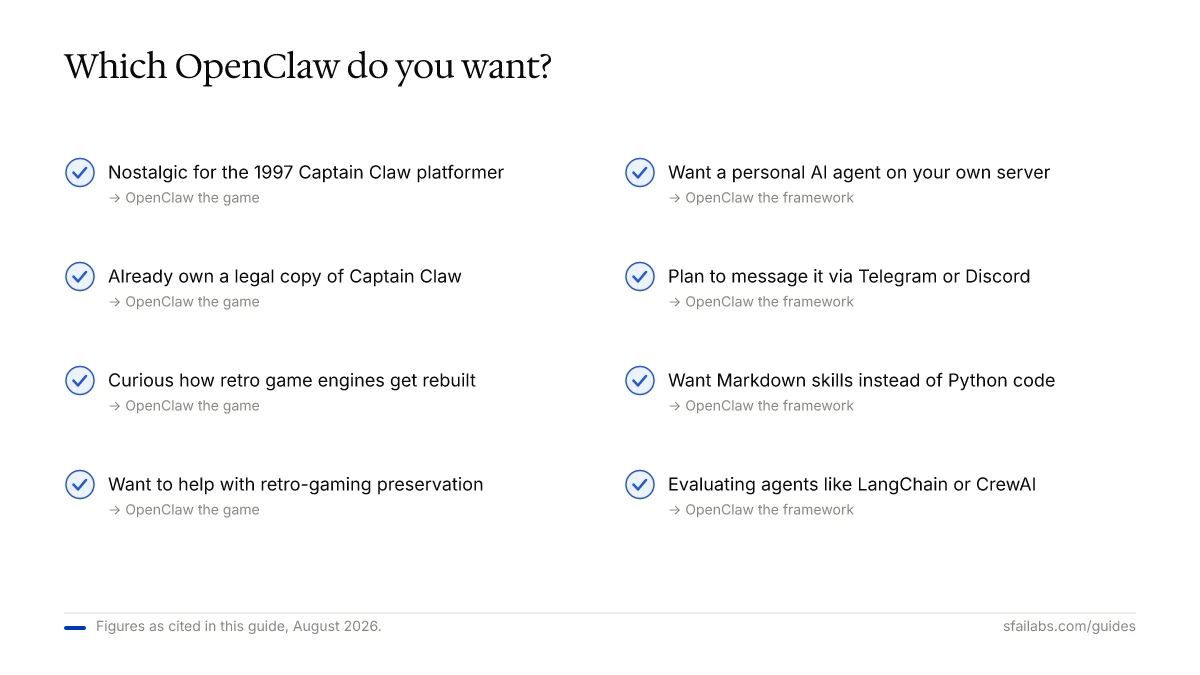
You want OpenClaw the game if:
- You are nostalgic for 1997 Monolith platformers and want to play Captain Claw on modern hardware.
- You already own a copy of Captain Claw and just need an engine that runs.
- You are interested in how open-source communities reimplement proprietary game engines.
- You want to contribute to retro-gaming preservation.
You want OpenClaw the AI framework if:
- You want a personal AI agent that runs on your own machine or VPS.
- You plan to send messages to it on Telegram, WhatsApp, or Discord and have it take action.
- You want to extend an agent’s behavior through Markdown skill files instead of Python code.
- You are evaluating open-source AI agents against alternatives like LangChain, CrewAI, or AutoGen.
If neither of those lists describes what you are doing, you likely wanted a different product entirely. A quick sanity check: search for what the project actually does rather than the name, for example “AI agent framework self hosted” or “Captain Claw PC port.”
Frequently Asked Questions
Is OpenClaw the game the same as OpenClaw the AI framework?
No. They are two unrelated open-source projects that share a name. The game is a C++ reimplementation of the 1997 Monolith platformer Captain Claw and lives at github.com/pjasicek/OpenClaw. The AI framework is a Node.js personal AI agent with 160,000+ GitHub stars and a completely different codebase, community, and purpose.
Is OpenClaw the game legal to use?
The engine source code is GPL-3.0 and legal to download, compile, and redistribute. The game’s data files (inside CLAW.REZ) are copyrighted 1997 Monolith material that the project does not and cannot ship. You must supply those files from a legally obtained copy of Captain Claw, either an original CD-ROM or a digital purchase when one is available.
Can I still buy Captain Claw in 2026?
Availability on digital storefronts has fluctuated over the years. Check GOG and Steam directly for current listings rather than relying on blog posts, which date quickly. Original CD-ROMs from the 1997 release still work. If you cannot find a legal copy today, that is a real blocker for using OpenClaw the game, and the project does not offer a workaround.
Why do blogs and AI assistants conflate the two OpenClaws?
Name collision plus rapid growth of the AI framework since 2024. Some blogs published under the name OpenClaw treat “modern rebirth of a 90s classic” and “next-generation open-source AI” as the same story, which they are not. If you see a single article that claims the game engine and the AI framework are the same thing, treat that source with caution.
Which project is bigger?
The AI framework is dramatically larger by every metric: GitHub stars (160,000+ vs. low hundreds), community contributions (13,700+ skills vs. a handful of forks), commercial attention, and search volume outside the retro-gaming niche. The game project is a focused, respectable fan effort. Size is not a value judgment, but it is the clearest signal when you are trying to figure out which OpenClaw a given article is discussing.
Where should I go next?
If you wanted the game, go to github.com/pjasicek/OpenClaw and read the README. If you wanted the AI framework, start with our OpenClaw AI agent framework overview and the installation guide.
Key Takeaways
- “OpenClaw” refers to two unrelated open-source projects. The game is a GPL-3.0 C++ reimplementation of the 1997 Monolith platformer Captain Claw. The AI framework is a 160,000+ star Node.js personal AI agent.
- The game requires
CLAW.REZfrom a legally obtained copy of Captain Claw. The engine is free and legal; the assets are not redistributable. - The game’s stack is C++, SDL2, Box2D, TinyXML. The framework’s stack is Node.js plus an LLM API key. If one of those sentences matches your search intent, that is the OpenClaw you want.
- The two projects have different maintainers, different communities, and different scales. Any article that treats them as one product is confused or deliberately conflating them.
- For AI agent guidance, use the SFAI Labs OpenClaw framework content. For retro-gaming, use the pjasicek/OpenClaw repository and PCGamingWiki’s Claw entry.
SFAI Labs