Running one OpenClaw agent is a weekend project. Running twelve across three projects is an operations problem. The difference has a name in the community: mission control. Search the term and you will find at least five self-hosted dashboards on GitHub, two editorial writeups, and a stack of 2026 orchestration platforms that all claim to solve the same thing. They do not solve the same thing, and most treat “mission control” as if it were a product.
It is not. It is a pattern. Specifically, it is the operator-facing layer that binds agent runtime (OpenClaw Gateway) to the five controls you need before you can safely run a fleet: routing, policy enforcement, telemetry, human-in-the-loop approvals, and cost caps. This article breaks the pattern down, maps the main open-source implementations onto it, and gives engineering leads a concrete decision framework for when they actually need it.
What Mission Control Means for Agent Fleets
In aerospace, mission control is the ground station that sees everything a distant vehicle is doing, holds authority to override it, and absorbs the cognitive load that the crew cannot. Agent fleets inherit the metaphor for the same reason: past a certain size, the operator cannot keep the state of every agent in their head, and the CLI stops being a viable interface.
For OpenClaw, mission control is the dashboard plus policy layer that sits above OpenClaw Gateway and exposes a single operator surface. It answers five operational questions at once:
- Which agents are running, and which are stuck?
- Is every action one of them takes allowed?
- What have they done, and can I reconstruct why?
- When should a human step in before the agent commits?
- How much has this cost me in the last hour, day, week?
A CLI can answer any one of these. A dashboard can answer two or three. Mission control, as a pattern, answers all five in one place. That is the whole reason the term has traction.
The Five Layers of a Mission Control Surface
Most writeups blur routing, policy, and telemetry together and call the result “orchestration.” Decomposing the layers is how you tell which open-source project covers what, and where you still have gaps.
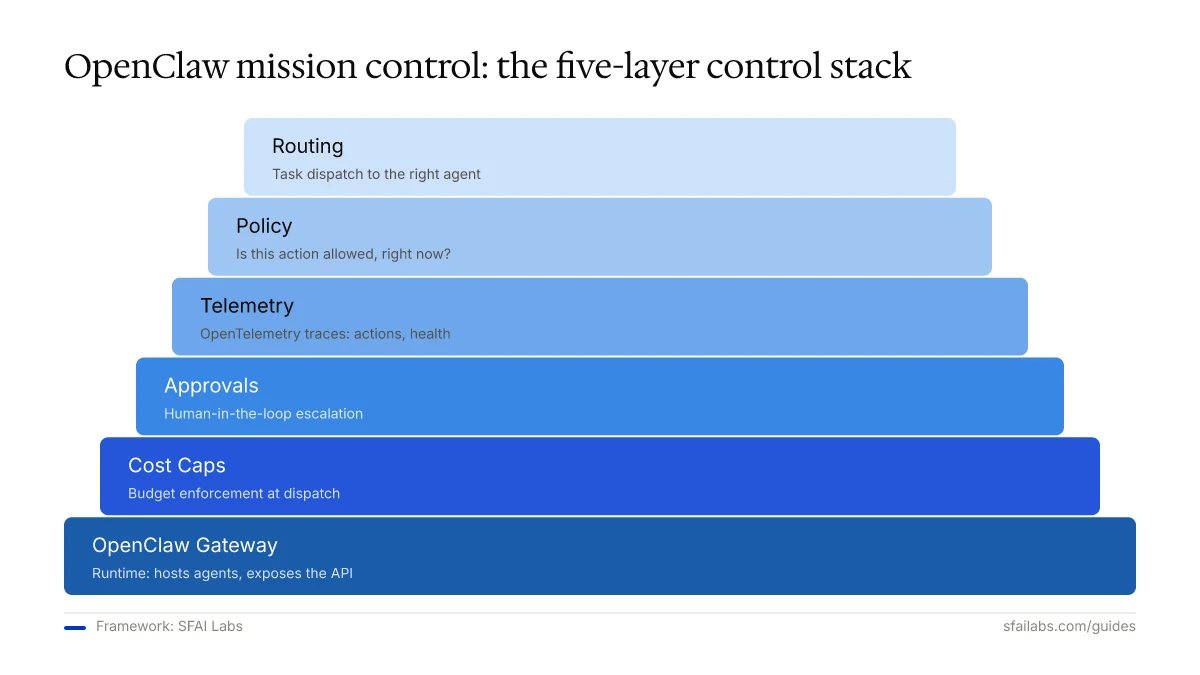
Routing
Routing is task dispatch. An incoming request or scheduled heartbeat needs to land on the right agent — on the right host, running the right skill, with the right inputs. At one agent this is trivial. At twelve it is a work queue problem with affinity rules: some agents are pinned to projects, some skills need specific tool access, some hosts have GPU and some do not.
Every serious mission control implementation exposes a task or job primitive. crshdn/mission-control calls this convoy mode — fleets of agents that accept dispatched work. abhi1693/openclaw-mission-control models it as boards and tasks in a Kanban flow.
Policy
Policy is the answer to “is this action allowed for this agent, right now, against this data?” The simple version is role-based access control: agent A can read the Notion workspace, agent B cannot. The non-trivial version is policy-as-code — declarative rules that govern tool use, data access, and which human must approve which kind of action. builderz-labs/mission-control positions governance as a first-class concern rather than an add-on; most other implementations treat policy as an approval checkbox.
Policy is the layer most hobby dashboards skip, and the first one that matters once a fleet crosses a team boundary.
Telemetry
Telemetry is logs, traces, and health. What did agent B do at 14:32, with what tool, and what did that tool return? The 2026 consensus across the orchestration landscape — visible in Microsoft Agent Framework, LangGraph, and the agentic observability playbooks — is that this should be emitted as OpenTelemetry traces. OpenTelemetry is vendor-neutral, which means you can point the same instrumentation at Honeycomb, Jaeger, Datadog, or a local OTLP collector without rewriting the agent.
Mission control dashboards typically visualize a subset of these traces directly (current status, recent actions, error surface) and defer long-form trace analysis to a dedicated observability backend.
Approvals
Approvals are the human-in-the-loop escalation policy expressed as UI. An agent about to send an email, spend money, or write to a production database pauses and asks. The operator approves, rejects, or edits and approves.
The naive version approves every step. It does not survive contact with a fleet — see the fatigue curve below. The mature version is an escalation policy: approve nothing by default, require approval on a named list of high-risk actions (external communication, spend over $X, writes to specific data stores), and batch approvals where possible.
Cost Caps
Cost caps are budget enforcement at dispatch time, not after the fact. A task that would push the agent over its monthly token budget refuses to start, rather than running and logging a cost overrun. crshdn/mission-control tracks cost per agent and per task; builderz-labs/mission-control adds per-task budget caps as a precondition.
Cost caps are the layer that becomes load-bearing the first time a retry loop goes wrong at 3 a.m.
OpenClaw Gateway as the Backplane
Mission control is not a replacement for OpenClaw Gateway. It sits on top of it.
The Gateway is the runtime: it hosts the agent processes, exposes an API surface, and handles the actual work of routing a request to a skill and running it. Mission control consumes that API — typically through REST endpoints for agent lifecycle, task dispatch, and event streams for telemetry — and wraps it in an operator UI plus policy enforcement.
That split matters when you evaluate dashboards. If a dashboard embeds its own runtime, you now have two systems to maintain and two places where agent state can drift. If it consumes a shared Gateway, multiple dashboards (or scripts, or CI jobs) can manage the same fleet. Every mainstream OpenClaw mission control project takes the second approach.
When You Actually Need Mission Control
Not every team needs this. The threshold is not about ambition — it is about the number of agents, the number of operators, and the blast radius of a mistake.
| Fleet size | Operator count | Adequate control surface |
|---|---|---|
| 1–2 agents | 1 operator | CLI plus log files |
| 3–6 agents | 1 operator | Dashboard (read-heavy) with manual approvals |
| 7–15 agents | 1–3 operators | Dashboard plus policy rules plus batched approvals |
| 15+ agents or multi-team | 3+ operators | Policy-as-code, SSO, audit trail, per-team quotas |
These thresholds are not arbitrary. They track the point at which the next failure mode shows up. Below three agents, you can keep state in your head. Between three and six, the approval cadence is manageable but logs become unscannable without a UI. Past seven, you will miss a stuck agent unless the dashboard tells you. Past fifteen, or once a second team touches the fleet, you need policy because coordination over Slack stops working.
Jumping to policy-as-code too early is waste. Running twelve agents from the CLI is the opposite kind of waste.
Failure Modes at Fleet Scale
The reason mission control matters is that fleets introduce failure modes that a single agent never exhibits. Five recur often enough to enumerate.
Silent tool loops. An agent calls a tool, gets an ambiguous result, and calls the same tool again. Without per-agent action telemetry you will not notice until the token bill arrives. Detection lives in the telemetry layer; mitigation lives in policy (rate limits on tool calls) and cost caps (dispatch refuses on budget).
Approval fatigue. An operator approving every step for six agents is making hundreds of decisions a day. Decision quality collapses inside a week. Mitigation is an explicit escalation policy, not more willpower.
Budget bleed from retries. Transient failures trigger retries. Retries compound across a fleet. Three agents each retrying three times on a $0.40 task is nine executions, not three. Mitigation is retry budgets enforced at the cost-cap layer, not just at the agent.
Gateway partition. Agents on different hosts lose sight of each other when one Gateway instance becomes unreachable. Without a mission control view, the operator does not know which agents are “missing” versus “idle.” Telemetry plus explicit health checks in the dashboard are the minimum fix.
State drift after restart. Without crash recovery or idempotent task dispatch, a Gateway restart mid-task leaves partial work. The mission control layer is where resumption logic lives — either by replaying the last known task or by marking it as needing human review.
The Human-in-the-Loop Fatigue Curve
Approval load scales linearly with agent count if every high-risk action pages a human. In practice the curve is worse than linear, because operators get slower as fatigue sets in. A team running four agents with default approvals will approve faster per action than the same team running ten.
Three patterns reduce the slope:
- Policy gating. Actions below a named threshold (e.g., read-only queries, spend under $5) never reach the operator. Only the exceptions do.
- Batching. Approvals queue for a short window and arrive as a batch. The operator approves a set of related actions in one review pass.
- Trusted paths. A skill that has been run a hundred times with manual approval graduates to automatic approval when its inputs match a known shape.
None of this is novel. It is the same pattern change-management teams use for production deploys. The lesson for agent fleets is that you have to apply it on purpose — the default in every open-source dashboard is “ask a human every time,” and that default does not scale.
How the Main Open-Source Implementations Compare
The public GitHub implementations converge on the lifecycle and dispatch primitives and diverge on policy and cost. This matrix is from the project READMEs as of April 2026 — features present out of the box, not features achievable through customization.
| Project | Routing | Policy | Telemetry | Approvals | Cost Caps |
|---|---|---|---|---|---|
| abhi1693/openclaw-mission-control | Yes (boards, tasks) | Partial (approval workflows, audit trail) | Partial (logs, not OTel) | Yes | No |
| crshdn/mission-control | Yes (convoy mode) | No | Partial (cost + events) | Partial | Yes (tracking, no enforcement) |
| builderz-labs/mission-control | Yes (workflow DAG) | Yes (governance-first framing) | Partial | Yes | Yes (per-task caps) |
| robsannaa/openclaw-mission-control | Minimal (single-host GUI) | No | Health only | No | No |
| carlosazaustre/tenacitOS | Yes | No | Basic | No | No |
The honest read: no open-source project ships all five layers at production depth. Most deliver routing and basic approvals well, handle telemetry adequately, and stop short of policy-as-code and enforced cost caps. This is consistent with the maturity of the ecosystem — the term “mission control” entered common use in the OpenClaw community in early 2026, and the implementations are still racing each other on fundamentals.
Where SFAI Labs Fits
At SFAI Labs we run agent fleets for clients and ourselves. That is the context in which we built our own dashboard work — not as a commercial product pitch, but because the open-source options each cover a subset of the five layers and we needed the full surface for client engagements with compliance requirements.
We do not claim feature parity with any specific open-source project. What we do claim is a point of view: if you are past the fifteen-agent threshold, or if a second team is touching your fleet, the gaps in the matrix above become operational risk, and at that point the decision is between stitching several dashboards together, building your own on the Gateway API, or working with a team that has already made the five-layer decomposition explicit.
If you are below that threshold, the right move is almost always to adopt one of the open-source projects and accept the gaps until they start biting. See our OpenClaw installation guide for the runtime setup that any of these dashboards sits on top of, and the OpenClaw AI Agent Framework piece for how the agent layer fits underneath.
Frequently Asked Questions
What is OpenClaw Mission Control?
OpenClaw Mission Control is the operator-facing layer that sits above OpenClaw Gateway and exposes five controls in one interface: task routing, policy enforcement, telemetry, human-in-the-loop approvals, and cost caps. It is a design pattern, not a single product — multiple open-source implementations exist on GitHub, each covering different subsets of the five layers.
Is Mission Control a product or a pattern?
Pattern. The term refers to the operator surface that binds agent runtime to the controls needed to run a fleet. Concrete implementations include abhi1693/openclaw-mission-control, crshdn/mission-control, builderz-labs/mission-control, and others. None of them is the canonical Mission Control; each covers a different slice of the pattern.
When do I actually need a mission control layer?
Below three agents, a CLI plus log files is adequate. Between three and fifteen agents, a dashboard with approvals and basic telemetry pays for itself. Past fifteen agents, or the moment a second team touches the fleet, you need policy-as-code, SSO, and an audit trail. Adopting policy tooling earlier than that is premature; running past fifteen agents without it is operational risk.
How does Mission Control relate to OpenClaw Gateway?
OpenClaw Gateway is the runtime that hosts and executes agents. Mission Control is the dashboard plus policy layer that consumes the Gateway’s API (agent lifecycle, task dispatch, event streams) and wraps it in an operator interface. Multiple dashboards can share a single Gateway, which is why the standard open-source pattern is dashboard-on-Gateway rather than dashboard-embeds-runtime.
How do approval flows and human-in-the-loop work?
The pattern that scales is an escalation policy, not approve-every-step. You name the high-risk actions — external communication, spend above a threshold, writes to specific data — and route only those to a human. Everything else executes automatically. Batching and trusted paths (auto-approve on known-safe input shapes) flatten the approval workload further.
How is cost governance enforced across a fleet?
Cost caps should be preconditions at dispatch, not postmortems in a log. A task that would push the agent or the fleet past its budget refuses to start. This requires the mission control layer to know both the agent’s current spend and the cost estimate of the pending task. builderz-labs/mission-control ships per-task caps; several others track cost without enforcing it.
What breaks at fleet scale that does not break with one agent?
Five failure modes recur: silent tool loops, approval fatigue, retry-driven budget bleed, gateway partition across hosts, and state drift after restart. None of them appear with a single agent and a single operator. All of them appear past roughly seven agents, and the mission control layer is where the fixes live.
How is OpenClaw Mission Control different from LangGraph Platform or Microsoft Agent Framework?
LangGraph Platform and Microsoft Agent Framework are orchestration runtimes with first-party operator tooling — they own both the agent execution model and the dashboard. OpenClaw Mission Control is a dashboard layer on top of an independent agent runtime (OpenClaw Gateway). The practical difference is that you can run multiple OpenClaw dashboards against one Gateway and swap them without touching the agents, which is harder to do inside an integrated platform.
Key Takeaways
- Mission control is a pattern — routing, policy, telemetry, approvals, and cost caps — not any single open-source project. Decomposing the layers tells you which project covers what.
- OpenClaw Gateway is the runtime; mission control sits on top. The dashboard-on-Gateway split lets multiple operator tools share one fleet.
- Fleet size dictates the control surface. CLI for one or two agents, dashboard for three to fifteen, policy-as-code past fifteen or multi-team.
- The failure modes that justify mission control — silent tool loops, approval fatigue, budget bleed, gateway partition, state drift — only appear at fleet scale. Below the threshold, extra tooling is waste.
- No open-source implementation ships all five layers at production depth today. Pick the one whose gaps you can tolerate, or build on the Gateway API directly.
SFAI Labs