Quick take: The no-code AI market hit $6.56 billion in 2025 and is projected to reach $75.14 billion by 2034, driven by two distinct tool categories that business owners frequently conflate: workflow automation platforms (Zapier, Make, n8n) and AI-powered app builders (Lovable, Bolt, v0, Bubble). Choosing the wrong category — not the wrong tool within a category — is the mistake most business owners make. This guide separates the two, gives you real pricing numbers, and flags the security and lock-in risks that vendor comparison sites omit.
The scale of adoption makes clear this is not hype. Lovable reached $300 million in annual recurring revenue by January 2026, less than 18 months after launch, growing faster than OpenAI, Cursor, and every other software company in history at the same stage. n8n raised $180 million at a $2.5 billion valuation in October 2025, backed by Nvidia and Accel, after hitting $40 million ARR with 10x year-over-year usage growth. Zapier, the incumbent, generates $310 million in annual revenue with 69% of Fortune 1000 companies in its customer base. These are real businesses with real revenue, not venture-backed demos.
The market split matters because the tools solve different problems. Workflow automation connects apps you already use and triggers actions between them. App builders generate functional software from a text prompt. Using Zapier to build a customer portal, or Lovable to trigger Slack notifications, means fighting the tool. Understanding which category fits your use case narrows the field from a sprawling 50-tool landscape to a list of three or four real candidates.
Two Categories, Not One List
The no-code AI landscape divides cleanly into two categories with different audiences, pricing structures, and failure modes.
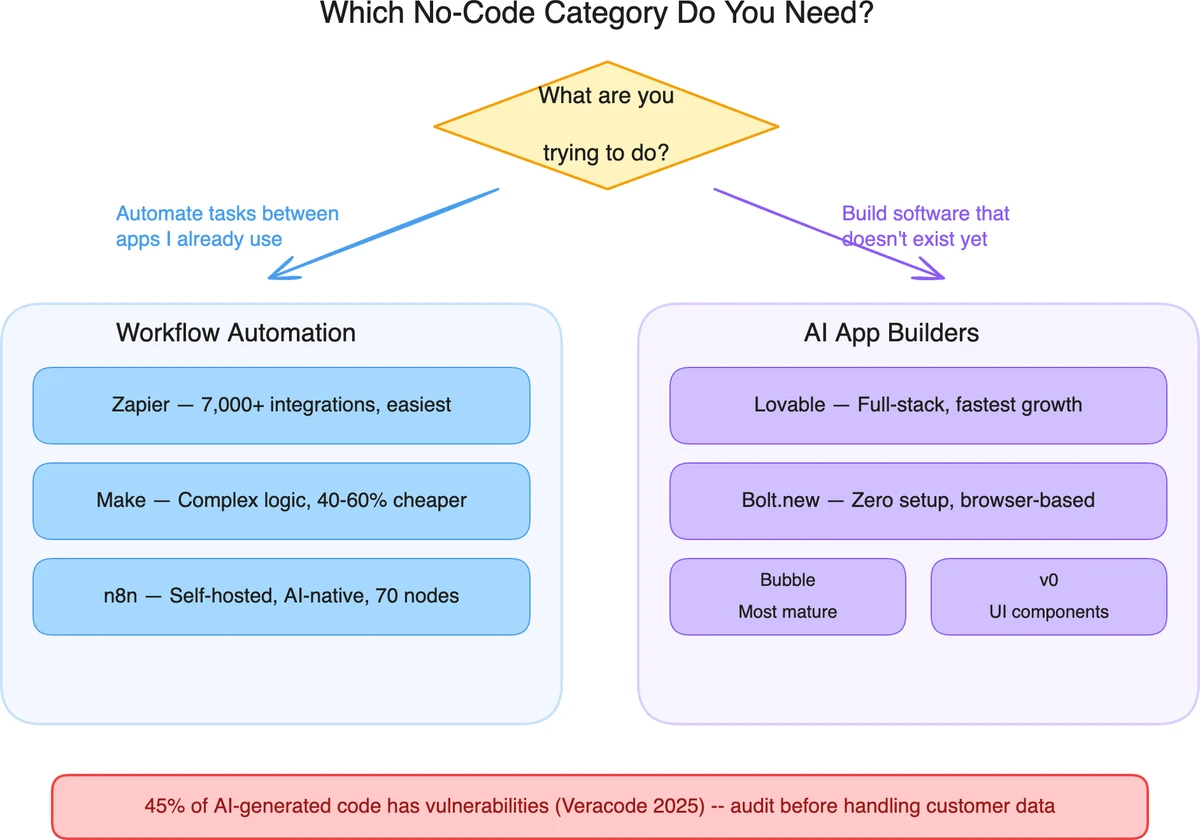
Workflow automation tools (Zapier, Make, n8n) connect existing software — your CRM, email, Slack, spreadsheets — and automate repetitive sequences between them. You do not build software; you orchestrate software you already pay for. These tools are appropriate for business owners who need to eliminate manual data entry, trigger notifications, sync records across platforms, or build multi-step processes without writing code.
AI app builders (Lovable, Bolt, v0, Bubble, Retool) generate functional software from natural language. You describe what you want — a client portal, an internal dashboard, a booking tool — and the platform generates working code. These tools are appropriate for business owners who need software that does not exist yet and cannot afford a development team to build it.
The pricing reflects this distinction. Workflow automation starts at free and scales with usage volume. App builders start at $20–$25/month and scale with features, team seats, and computational complexity.
Workflow Automation Tools
Zapier
Zapier dominates workflow automation for small businesses with 7,000+ app integrations — no competitor comes close on breadth. The platform generated $310 million in revenue in 2024, with small businesses accounting for 40% of its customer base. 69% of Fortune 1000 companies use it, which signals enterprise-grade reliability.
Pricing follows a per-task model where every individual action counts as one task. The free plan handles 100 tasks per month across two-step automations. Paid plans start at $19.99/month (750 tasks) and scale to $599/month for teams with advanced data transformation and AI features. At high automation volumes, Zapier becomes expensive relative to alternatives.
The platform’s AI layer — Zapier AI — connects natively to OpenAI, Anthropic, and Google Gemini, allowing business owners to embed AI actions (summarize, classify, generate text) inside existing workflows without code. The practical limit is complexity: Zapier handles linear automations well but struggles with branching logic, error recovery, and custom business rules that require conditional paths.
Best for: Non-technical business owners who need fast setup, maximum pre-built integrations, and simple trigger-action workflows.
Make.com
Make (formerly Integromat) delivers visual workflow power at roughly 40–60% lower cost than Zapier for equivalent usage volumes. The platform charges per “operation” rather than per individual task, and its visual canvas lets you see the entire automation as a flowchart — useful when debugging multi-path workflows.
Make’s pricing: Free (1,000 operations/month), Core at $9/month (10,000 operations), Pro at $16/month, Team at $29/month. The platform integrates with 3,000+ apps and supports advanced branching, scheduling, and error handling that Zapier’s interface limits.
The tradeoff is a steeper learning curve. Make’s visual builder rewards users who understand their workflow end-to-end before building it. Business owners who want to build fast without understanding the underlying logic often find Make’s additional flexibility confusing rather than empowering.
Best for: Business owners with moderate technical comfort who need complex multi-path automations at lower per-operation cost.
n8n
n8n is the only workflow automation platform that is genuinely self-hostable, open-source, and AI-native. The Berlin-based company raised $180 million in October 2025 at a $2.5 billion valuation with Nvidia as a strategic investor — a signal that the market views n8n as infrastructure for AI workflows, not just another Zapier alternative. The platform serves 230,000+ active users and 3,000 enterprise customers including Vodafone, Delivery Hero, and Microsoft.
The pricing model differs from Zapier and Make. Cloud plans start at $24/month for 2,500 workflow executions, where an execution is one complete workflow run regardless of how many steps it contains (a significant cost advantage at scale). Self-hosting is free for internal use under the Sustainable Use License, with no per-execution limits. n8n offers nearly 70 dedicated AI nodes covering LangChain, vector databases, and model providers, making it the strongest choice for building AI agent workflows.
The limitation is setup time. Cloud n8n requires less technical knowledge, but self-hosted deployment requires a server, domain, and basic infrastructure management. For teams processing high workflow volumes or building agentic AI sequences, the per-execution pricing model and AI-native architecture justify the complexity.
Best for: Technical business owners, developer-adjacent teams, and organizations with data sovereignty requirements who need AI-native automation at scale.
| Platform | Free Tier | Entry Paid | Unit Pricing | AI Native | Self-Hosted |
|---|---|---|---|---|---|
| Zapier | 100 tasks/month | $19.99/month | Per task | Yes | No |
| Make | 1,000 ops/month | $9/month | Per operation | Yes | No |
| n8n | Self-hosted free | $24/month | Per execution | Yes (70 AI nodes) | Yes |
AI App Builders
Lovable
Lovable is the fastest-growing software company in history at equivalent stages of maturity, reaching $100 million ARR faster than OpenAI. By January 2026, Lovable hit $300 million ARR with approximately 8 million total users and 180,000+ subscribers. In December 2025, the company raised $330 million at a $6.6 billion valuation. The platform was founded by the team behind GPT Engineer and targets non-technical users who need full-stack web applications.
Lovable’s approach converts natural language prompts into complete applications with backend, database, and authentication. A business owner can describe a client feedback portal, a job applicant tracker, or a custom CRM — and receive a deployed, functional application within minutes. Starter plans begin at $25/month.
The security record warrants scrutiny. In 2025, a critical vulnerability in Lovable’s code generation exposed over 170 applications due to missing Row Level Security (RLS) policies in the generated database code. Independent security researchers also found that Lovable, alongside Bolt and Base44, consistently generated code vulnerable to stored cross-site scripting (XSS) attacks even when explicitly prompted for secure output. These are not theoretical risks for business owners handling customer data.
Best for: Non-technical founders who need full-stack applications fast and accept that generated code requires security review before handling sensitive data.
Bolt.new
Bolt.new, built by StackBlitz on its WebContainer technology, delivers browser-based full-stack development with zero local setup. StackBlitz has raised approximately $135 million in total funding. By March 2025, over 1 million AI-generated websites had been deployed via the Bolt and Netlify integration.
The platform’s core advantage is frictionlessness. There is no IDE to install, no environment to configure, no deployment pipeline to wire up. You describe what you want in the browser, the application runs in the browser, and you deploy from the browser. For prototypes, hackathon demos, and low-stakes internal tools, this workflow removes every barrier between an idea and a working URL.
Bolt uses a token-based pricing model with plans starting around $20/month. The same security caveats that apply to Lovable apply to Bolt — the platform has been shown to generate XSS-vulnerable code, and applications handling customer data require security review by someone who understands the generated output.
Best for: Business owners and non-technical founders who need working prototypes fast, with no setup overhead and no preference for a specific tech stack.
v0 by Vercel
v0 occupies a distinct niche: it generates production-ready React and Tailwind CSS components, not complete applications. The tool is built and maintained by Vercel, which supports over 6 million developers and 80,000 active teams. Pricing runs Free ($5 in monthly credits), Premium at $20/month, and Team at $30/user/month.
v0 shines in specific scenarios — generating a pricing table, a data dashboard, a multi-step form, or a landing page section — and falls short when you need backend logic, user authentication, or database connections. The output is clean, production-ready code that a developer can drop into an existing Next.js project. For business owners without developers, v0 alone does not deliver a deployable application.
Best for: Business owners working alongside a developer who can use v0 output to accelerate front-end build speed, or technical founders who want AI-generated UI components for their own projects.
Bubble
Bubble is the original no-code app platform, founded in 2012 and hosting 4.7 million applications as of August 2025. Users of Bubble-built applications have collectively raised over $15 billion in venture funding, making it the most proven platform for non-technical founders building investor-backed products. The company has raised over $150 million and employs 400+ people.
Bubble’s visual builder is more complex than AI-prompt-based tools — you design database structures, workflows, and UI components through a drag-and-drop canvas rather than natural language. In October 2025, Bubble launched its AI Agent feature, which allows users to describe desired functionality in plain English and receive implemented features. Pricing runs approximately $25/month for personal use and $475/month for production-level applications with custom domains and removed branding.
The platform’s strength is maturity. Where Lovable and Bolt output code that you can inspect and modify, Bubble stores your application in its proprietary format. Migrating a complex Bubble application off the platform is genuinely difficult — this is vendor lock-in in a meaningful sense, not just a theoretical concern.
Best for: Non-technical founders building customer-facing SaaS products who prioritize platform maturity and community support over build speed or code ownership.
Retool
Retool is positioned differently from other app builders: it focuses exclusively on internal business tools — admin panels, customer dashboards, operational interfaces — rather than customer-facing applications. The company has raised $141 million at a $3.2 billion valuation, with Sequoia Capital leading the Series C. Enterprise customers include AWS, DoorDash, and Brex.
Retool’s pricing model charges per seat: $49/month per internal builder plus $15/month per external end-user. For a team of 3 builders serving 50 internal users, that runs $147/month in builder seats plus $750/month in user seats. This pricing makes sense for replacing expensive off-the-shelf enterprise software but is expensive for small teams compared to Bubble or Bolt for similar functionality.
Best for: Operations-heavy companies that need sophisticated internal tools with role-based access control, audit logs, and reliable database connectivity.
| Platform | Starting Price | Target User | Output Type | Lock-In Risk |
|---|---|---|---|---|
| Lovable | $25/month | Non-technical founders | Full-stack app | Low (exports code) |
| Bolt.new | ~$20/month | Non-technical founders | Full-stack app | Low (exports code) |
| v0 | Free / $20/month | Developer-adjacent | UI components only | Low |
| Bubble | $25/month | Non-technical founders | Customer-facing SaaS | High (proprietary format) |
| Retool | $49/builder/month | Operations teams | Internal tools | Medium |
Where No-Code AI Tools Fall Short
Every platform in this guide has limitations that vendor comparison sites omit. The practical failure modes matter more than feature lists.
Security is the most underreported risk. Veracode’s 2025 GenAI Code Security Report found that 45% of AI-generated code contains security vulnerabilities. Lovable’s 2025 exposure of 170+ applications is the most documented example, but the pattern extends across all AI app builders. Business owners who build customer-facing applications with user accounts, payment information, or sensitive data need someone who can read and audit the generated code. The tool generating the application cannot substitute for that review.
Vendor lock-in varies sharply by tool. Lovable and Bolt export raw code you can take anywhere. Bubble stores applications in a proprietary format — migrating complex workflows is a months-long engineering project. The collapse of Builder.ai, once a $1.3 billion-valued AI app platform, left customers without access to their own software. Choosing platforms that export code protects against this outcome.
Automation tools scale costs unpredictably. Zapier’s per-task model means a workflow that runs 50 times per day generates 1,500 tasks per month. A complex automation with 10 steps running at that frequency generates 15,000 tasks — jumping from the $19.99 tier to $49/month or higher. Model the task volume before committing to a paid plan.
Most AI tools do not learn from your data. n8n, Zapier, and Make execute workflows against current data but do not improve over time. AI app builders generate code from a prompt but do not evolve the application based on user behavior. The intelligence is in the generation, not the operation.
Frequently Asked Questions
What is the best no-code AI tool for a business owner with no technical background?
Lovable and Bolt.new are the most accessible for non-technical business owners who need complete applications. For workflow automation without building software, Zapier is the simplest starting point with 7,000+ integrations and a free tier. The right choice depends on whether you need to build new software (use Lovable or Bolt) or automate existing software you already use (use Zapier or Make).
How much do no-code AI tools cost per month in 2026?
Workflow automation: Zapier free tier handles 100 tasks/month; paid plans run $19.99–$599/month. Make runs $9–$29/month. n8n self-hosted is free; cloud starts at $24/month. App builders: Lovable starts at $25/month, Bolt at approximately $20/month, v0 at $20/month, Bubble from $25/month (personal) to $475/month (production). Retool charges $49/builder/month plus $15/end-user/month.
Are no-code AI app builders secure enough for handling customer data?
Not without security review. Veracode’s 2025 report found 45% of AI-generated code contains security vulnerabilities. Lovable exposed 170+ applications due to missing Row Level Security in generated database code. Tools like Lovable and Bolt export raw code, so a developer or security-aware contractor can audit and fix the output. Platforms that do not export code — primarily Bubble — require trusting the platform’s own security controls. Any application handling payment information, health data, or user credentials should be reviewed by someone who can read the underlying code.
What is the difference between Zapier, Make, and n8n?
All three automate workflows between apps, but with different pricing models, complexity ceilings, and philosophies. Zapier charges per individual task (every step counts), has 7,000+ integrations, and prioritizes ease of use. Make charges per operation (more efficient at scale), has 3,000+ integrations, and supports more complex branching logic. n8n charges per complete workflow execution (most cost-efficient at high volume), is open-source and self-hostable, and has native support for AI agent workflows with 70 dedicated AI nodes. Zapier suits beginners; Make suits power users on a budget; n8n suits technical teams building AI-native automation.
Can no-code AI tools replace a software development team?
For specific, well-defined applications, yes — Bubble-built startups have raised $15 billion in venture funding, demonstrating that investors accept no-code-built products as viable businesses. For complex, security-sensitive, or high-scale applications, no. The 45% vulnerability rate in AI-generated code means customer-facing applications need developer review. The lack of customization depth means enterprise-grade requirements — custom authentication systems, complex data pipelines, real-time features at scale — still require engineering teams. The practical answer is that no-code tools reduce, but do not eliminate, the need for technical talent.
What is n8n and why is it different from Zapier?
n8n is an open-source workflow automation platform that raised $180 million at a $2.5 billion valuation in October 2025 with Nvidia as an investor. Unlike Zapier, n8n can be self-hosted on your own servers, charges per complete workflow execution rather than per individual step, and includes nearly 70 dedicated AI nodes for building AI agent workflows with LangChain, vector databases, and model providers. For teams running high-volume automations or building AI-native workflows, n8n’s pricing model and AI infrastructure are materially better than Zapier’s. For teams that want setup simplicity and the broadest app integration library, Zapier remains the faster path to working automations.
Key Takeaways
- The no-code AI market splits into two distinct categories: workflow automation (Zapier, Make, n8n) and AI app builders (Lovable, Bolt, Bubble, v0). Using a tool from the wrong category is the primary source of failure.
- Zapier leads workflow automation at $310M annual revenue with 7,000+ integrations; n8n is the AI-native alternative with self-hosting, 70 AI nodes, and a $2.5B valuation after its October 2025 Series C.
- Lovable reached $300M ARR by January 2026 with ~8 million users — the fastest software ARR ramp in history — but exposed 170+ applications due to security vulnerabilities in generated code.
- 45% of AI-generated code contains security vulnerabilities (Veracode 2025). Any customer-facing application handling sensitive data requires code review by someone technical, regardless of which AI builder produced it.
- Vendor lock-in risk is real and uneven: Lovable and Bolt export raw code; Bubble uses a proprietary format that makes migrations difficult; Builder.ai’s collapse at $1.3B valuation showed what happens when customers do not own their own software.
- For workflow automation at scale, n8n’s per-execution pricing model delivers materially lower costs than Zapier’s per-task model at high automation volumes. A workflow with 10 steps running 1,500 times per month costs 15,000 Zapier tasks but 1,500 n8n executions.
SFAI Labs