Most maintenance triage advice sorts requests by how bad they are — emergency, urgent, routine — then leaves you where you started: a queue that still needs a person to pick a vendor, get a quote, and schedule the work. Severity tells you how fast to move, not who moves. For a firm of four to twenty people with no dispatch desk, that second question is the whole game. This framework sorts every request by a different axis — who has to touch it next — into three lanes: urgent, routine, and vendor-direct. Set the rules once, let an AI intake layer do the sorting, and two of the three lanes stop reaching your desk at all.
Why severity is the wrong sort
The standard taxonomy is not wrong — just incomplete. Emergency, urgent, and routine are real distinctions, and every firm needs response-time targets tied to them: emergencies under two to four hours, urgent repairs inside 24 to 48 hours, routine work acknowledged within a day and completed inside a week (FirstService Residential).
The problem is that severity was designed for a firm with a maintenance coordinator — a person whose job is to receive the sorted queue and dispatch it. A 4–20 person firm has no such person. The principal, or one ops generalist wearing four hats, is the queue. A taxonomy that ends with “now assign it” hands every ticket back to the one bottleneck you were trying to relieve.
Look at where a small firm actually loses hours. Not the 2 a.m. flood — those get handled because they scream. It is the middle of the distribution: the garbage disposal that stopped working, the slow drain, the cabinet hinge. None of it is urgent, yet all of it still requires someone to read the message, decide it needs a plumber rather than a handyman, find a vendor who answers, get a rough price, and put it on a calendar. Multiply that by a few hundred doors and the routine bucket, not the emergency bucket, is what eats the week — because every ticket carries the same “routine” label while demanding wildly different amounts of attention.
The three lanes: urgent, routine, vendor-direct
Sort by the decision instead of the danger. Every inbound request lands in one of three lanes.
Urgent — a human must act now. A person is notified immediately and owns the response until it is closed. This lane is narrow by design: life-safety, active property damage, and loss of an essential service. It should be the smallest of the three by volume and the only one that can interrupt someone’s evening.
Routine — schedule it; a human picks the vendor. The request is real work but carries judgment: which trade, which vendor, whether it is worth a repair or a replacement, whether it is the owner’s cost or the tenant’s. It goes into a scheduling queue with a target date, and a person makes the vendor call. This is the lane most firms run everything through today.
Vendor-direct — auto-dispatch to a standing vendor, no human decision. For a defined set of common, low-ambiguity, low-cost jobs, no decision is worth a person’s time. Send the work straight to a pre-approved vendor under a spend cap, notify the tenant, and log it — with no stop at anyone’s desk. This is the lane almost nobody names explicitly, and it is where the real gain sits. Every ticket you move from routine to vendor-direct is a decision you never have to make again.
The framework shrinks the routine lane from both sides: push genuine emergencies up into urgent, push repeatable low-stakes jobs down into vendor-direct, and let the middle lane hold only what needs your judgment. The classic emergency/urgent/routine model is the raw severity signal you feed into this routing decision. For a survey of the tools that produce that signal, our rundown of the best AI maintenance-triage tools for small property managers compares the products that do the classifying.
The category-to-lane rule table
The framework only works if the routing is a rule, not a judgment call made fresh each time. Write the rule once, as an owner, and the intake layer applies it to every request. Here is a starting table a small property team can adopt more or less as-is and then tune.
| Request category | Default lane | Why |
|---|---|---|
| Gas smell, sparking outlet, active flooding, no heat in winter | Urgent | Life-safety or rapid property damage; a person owns it now |
| No hot water, sewage backup, security/lock failure, no A/C in heat | Urgent | Habitability loss; SLA measured in hours |
| Garbage disposal, running toilet, slow drain, minor leak | Vendor-direct | High volume, one trade, predictable cost, standing vendor |
| Appliance not working, HVAC not cooling (non-extreme), fixture repair | Routine | Repair-vs-replace judgment; vendor and cost need a decision |
| Cosmetic, cabinetry, paint, blinds, landscaping | Routine or vendor-direct | Low urgency; route to a standing handyman under the cap |
| Pest, mold, water intrusion of unknown source | Urgent (review) | Ambiguous scope and possible habitability/legal exposure |
| Anything the classifier cannot place with confidence | Routine (human) | Unknowns default to a person, never to auto-dispatch |
Two rules govern the table. First, ambiguity always routes up, never down — a borderline request goes to a human, and possible-emergency categories go to urgent even when they might turn out minor. The cost of over-escalating a running toilet is a wasted glance; the cost of under-escalating a mold complaint is a habitability claim. Second, the vendor-direct lane is a whitelist, not a default — a category earns its place only after you decide the job is common, single-trade, and capped. Everything else falls to routine.
How the vendor-direct lane stays safe
Auto-dispatching work without a human in the loop sounds reckless until you see the guardrails, which are simple and mechanical.
A standing vendor per trade. Pre-select one plumber, one handyman, one HVAC contractor, and agree rates in advance. Vendor-direct work only ever goes to these standing vendors, so there is no vendor-selection decision to automate — you already made it.
A hard spend cap. Each vendor-direct job carries a not-to-exceed number, say a few hundred dollars. If the vendor’s assessment comes back above it, the ticket automatically bounces to routine for a human to approve. The cap is the circuit breaker: the automation can dispatch, but it cannot spend real money without a person.
A tenant notification and a log entry. Every auto-dispatched job triggers a message to the tenant and a timestamped record — who was sent, for what, under which cap. Nothing happens silently. The log is what lets you review the lane weekly and move categories in or out.
A weekly exception review. Once a week, someone scans the vendor-direct log for anything that came back over cap, got reopened, or drew a complaint. That review is the entire management overhead of the lane — a few minutes against dozens of tickets that never touched a desk. It mirrors the discipline behind every reliable back-office automation: the machine does the volume, a person owns the exceptions. The same principle runs through our back-office automation playbook, which treats a human review layer as a design feature, not a failure.
The three categories that must always stay human
A framework that automates everything is a framework nobody trusts. Draw the line explicitly, and draw it in writing, so no one is tempted to widen the vendor-direct whitelist into territory it does not belong.
Life-safety. Gas, fire, electrical hazard, carbon monoxide, structural failure. These route to a person immediately and never enter any queue that can defer them. AI can flag them faster than a human reading an inbox — a genuine use — but the response is owned by a person from the first second.
Legal and habitability exposure. Anything that could become a code violation, a warranty-of-habitability claim, or a dispute: mold, water intrusion, heat or hot-water loss, pest infestation, accessibility. The cost of getting these wrong is measured in liability, not repair dollars, so a human makes and documents the call.
Ambiguity. The single most important rule in the whole framework: when the classifier is not confident, a person decides. Mature AI triage systems already work this way, routing any request below a confidence threshold — often around 70% — to human review rather than guessing (The AI Consulting Network). Your framework should inherit that behavior as a hard rule: unknowns default to a person, and they default to the safe side.
Where AI actually fits
Notice that the framework has worked so far without AI doing anything heroic — deliberately. AI’s job here is narrow and well within what current tools do reliably: read an incoming request in plain language, extract category and severity, and route it into the lane your rule table specifies. It is a classifier feeding a decision tree you designed, not an autonomous dispatcher improvising.
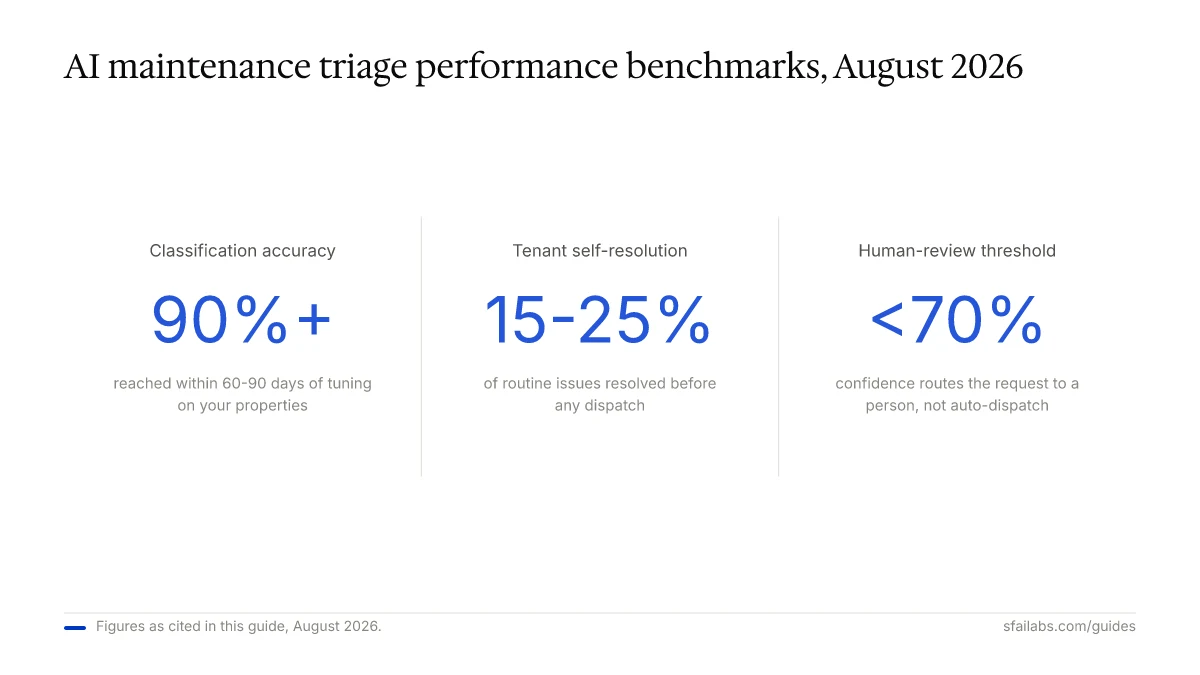
The performance is good enough for exactly that. Modern maintenance-triage AI reaches 90% or higher classification accuracy within 60 to 90 days of tuning on your own properties and vendor list, and resolves a meaningful share of routine issues — a 15% to 25% self-resolution rate is the mature benchmark — by walking a tenant through obvious fixes before any truck is dispatched (Haven). Those self-resolved tickets are a bonus outcome your framework gets for free: requests that never enter any lane because a tripped breaker or a disposal reset fixed itself.
The classifier can live in the maintenance AI built into AppFolio, Buildium, or Yardi, in a dedicated layer like Property Meld, or in a general assistant such as ChatGPT or Claude prompted against your rule table. What matters is not which product but that the routing logic is yours, written down, and auditable. For the money side of that build-versus-subscribe choice, our breakdown of what workflow automation costs a small property firm puts numbers against each path.
What the lanes do to your staffing math
The framework’s real payoff is structural. When two of three lanes never reach a human, the doors one generalist can carry rises sharply, because their attention goes only to the routine lane and the weekly review — not to every ticket.
If the vendor-direct whitelist and tenant self-resolution together cover a large share of inbound volume, and urgent items are rare by definition, the routine lane — the only one that consumes real coordination time — is a fraction of total tickets. A coordinator drowning at 150 doors handling everything can plausibly carry several times that when they handle only the middle. This is the small firm’s genuine advantage: you can redesign the workflow in a quarter, where an institutional operator is locked into a dispatch-desk org chart it would take a reorg to change. The case that small CRE firms out-operate institutional giants by removing coordination overhead rather than adding headcount is this move applied across the back office.
The framework does not eliminate the coordinator; it changes the job from processing a queue to owning exceptions and judgment calls.
How to stand this up in two weeks
You do not need a software project to adopt the framework — three decisions and a place to enforce them.
Week one — write the rules. Pick your standing vendor per trade and agree rates, set the spend cap, fill in the category-to-lane table for your actual request mix (erring toward routine wherever you are unsure), and write down the never-automate list. An afternoon of decisions, not a build.
Week two — wire the intake. Turn on the maintenance AI in your existing platform, or point a general assistant at your rule table, and route the three lanes: urgent to an immediate notification, routine to your scheduling queue, vendor-direct to your standing vendors under the cap. Start with a deliberately short whitelist and confirm the cap and tenant notification fire correctly.
Then tune weekly: every category that moves cleanly through vendor-direct for a month is a keeper; anything that bounces or draws complaints goes back to routine. Driving that widening confidence, one category at a time, is the kind of judgment a short LLM-fluency workshop is meant to build.
FAQ
What is the maintenance triage framework?
It sorts every maintenance request by who has to touch it next, into three lanes: urgent (a human acts immediately), routine (scheduled, with a human choosing the vendor), and vendor-direct (auto-dispatched to a pre-approved vendor under a spend cap, no human decision). It replaces the usual emergency/urgent/routine severity sort, which tells you how fast to move but not who moves — the question that bottlenecks a small firm with no dispatch desk.
How is this different from the emergency/urgent/routine model?
Emergency/urgent/routine sorts by severity — how dangerous the problem is. This framework sorts by routing — who makes the next decision. The two work together: the severity signal your software already produces feeds the routing choice. Severity sorting still hands every ticket back to a person to assign; routing sends two of three lanes somewhere other than your desk.
What belongs in the vendor-direct lane?
High-volume, single-trade, low-cost, low-ambiguity jobs: running toilets, garbage disposals, slow drains, minor fixture repairs, basic handyman work. A category earns a place on the whitelist only after you confirm it goes to one standing vendor at a known rate under your spend cap. Everything not explicitly whitelisted stays in the routine lane.
Isn’t auto-dispatching maintenance without a human risky?
Only without guardrails. The vendor-direct lane is safe because of four mechanics: work goes only to standing vendors you pre-selected; every job carries a not-to-exceed cap that bounces over-budget work to a human; every dispatch notifies the tenant and writes a log; and a weekly review scans that log for exceptions. The automation can dispatch a known job to a known vendor at a known price — but it cannot spend real money or act on an unknown without a person.
Which requests should never be automated?
Three categories always stay with a person: life-safety (gas, fire, electrical, structural), legal or habitability exposure (mold, water intrusion, heat or hot-water loss, pests, accessibility), and anything the classifier cannot place with confidence. The governing rule is that ambiguity always routes up to a human and to the safer lane, never down to auto-dispatch.
Can AI actually classify maintenance requests accurately enough?
Yes, for the narrow job of reading a request and assigning a category and severity. Current maintenance-triage AI reaches 90% or higher accuracy within 60 to 90 days of tuning on your properties, and routes low-confidence requests — typically below about a 70% threshold — to human review instead of guessing. Here AI is a classifier feeding rules you wrote, which keeps it inside what the technology does reliably.
Do I need to buy a dedicated triage tool to use this framework?
No. The classifier can run inside the maintenance AI built into AppFolio, Buildium, or Yardi, in a dedicated layer such as Property Meld, or in a general assistant like ChatGPT or Claude prompted against your rule table. What matters is that the routing logic is yours, written down, and auditable.
How much time does this actually save a small firm?
The saving comes from volume that never reaches a person. Tenant self-resolution handles a mature 15% to 25% of routine issues before any dispatch, and the vendor-direct lane removes much of what remains, leaving only the routine middle and rare urgent items for a human — which can lift the doors one coordinator carries several times over.
Key takeaways
- Sort maintenance requests by who touches them next, not just by how bad they are: urgent (human now), routine (scheduled, human picks vendor), vendor-direct (auto-dispatch under a cap, no human).
- The routine lane is where a small firm loses hours; shrink it by pushing genuine emergencies up to urgent and repeatable low-stakes jobs down to vendor-direct.
- The vendor-direct lane stays safe through four mechanics — standing vendors, a hard spend cap, tenant notification plus a log, and a weekly exception review.
- Three categories never automate: life-safety, legal/habitability exposure, and any request the classifier cannot place with confidence — ambiguity always routes up to a person.
- AI’s role is narrow and reliable: classify category and severity, then route into rules you wrote — a job current tools do at 90%+ accuracy, with low-confidence requests deferred to a human.
Want to know whether your maintenance workflow — or the rest of your back office — is ready for this kind of routing? A short conversation about your door count, your request mix, and where your team’s hours actually go will size it faster than any benchmark. Book your free AI-readiness assessment → and we will map which lanes your firm can automate first.
Arthur Wandzel