There are three ways to turn a stack of leases into structured data you can actually use, and they are not variations on one product — they are three different things you can buy. You can buy the work: hand your leases to a managed service and get finished abstracts back. You can buy the tool: license AI software, upload leases yourself, and review what it extracts. Or you can build the tool: commission a custom automation shaped to your exact fields and workflow. Most articles that rank for this comparison were written by a vendor selling one of the three, so each one argues the other two are slow, inaccurate, or overkill. This one sorts the decision the way a 4–20 person firm actually has to sort it — around three variables that decide it before you compare a single feature.
The real question: buy the work, buy the tool, or build the tool
The phrase “lease abstraction” hides a procurement decision that has almost nothing to do with abstraction quality. On clean, digitally native leases, every serious option now extracts the standard economic terms — parties, premises, base rent, escalations, term and options, CAM and operating-expense treatment — at high accuracy. Extraction is close to a solved problem. What differs is who does the reviewing, who owns the output format, and how the cost is shaped — per lease, per month, or as a one-time build.
So the honest way to frame it is not “which is most accurate.” It is: do you want to pay someone else to produce finished abstracts, pay for software and do the last mile yourself, or pay once to build a machine that does it your way forever? Each answer fits a different firm. Get the frame right and the choice mostly makes itself. This piece is the decision layer under the broader question of turning lease stacks into structured data.
What lease abstraction services actually are
A lease abstraction service is a managed operation you hand leases to and receive structured abstracts back from. The category runs from offshore and onshore business-process providers, to paralegal teams at law firms, to the onboarding and abstraction services that platform vendors bundle when you load a portfolio. Increasingly, the better ones run AI extraction internally and put a trained human on top of it — which means when you buy a modern service, you are often buying software you never see plus the review labor to make its output trustworthy.
The thing you are actually purchasing is removed work and transferred risk. You do not touch a tool, hire a reviewer, or maintain anything: you send documents, agree on a field template and a turnaround, and get back abstracts to a quality standard the provider stands behind. For a firm onboarding a newly acquired portfolio — a few hundred legacy leases to capture once, accurately, on a deadline — that is a genuinely good deal, because the work is a spike, not a standing need.
What a service does not give you is control or better economics on the recurring case. The output lands in the provider’s template, not necessarily yours; every new batch is a new invoice; and the per-lease price carries the provider’s own AI cost plus their review labor plus their margin. That is why services run the highest per document of the three paths — you are paying for the outcome, not the mechanism.
What AI lease-abstraction software actually is
AI lease-abstraction software is a tool you license and run yourself: upload a lease, the model extracts the fields, you review and correct, and the data lands in the product’s database or an export. Some tools are narrow extractors priced per lease. Others — platforms such as Prophia and Leasecake — wrap AI-assisted abstraction inside a standing system of record with a searchable lease database, critical-date alerts, and reporting, priced as an annual subscription. Because proptech feature sets change every quarter, confirm any specific capability on the vendor’s current documentation and against your own leases in a demo rather than on a claim in an article. We compare the leading options in our roundup of the best AI lease-abstraction tools for small CRE firms.
What you are buying here is the mechanism plus the review seat. The software does the extraction; you supply the human who approves the high-stakes fields — renewal options, CAM caps, co-tenancy — where a wrong value is expensive. That review labor is the cost line vendors leave out, and at volume it is often larger than the license fee itself. Software wins when abstraction is a standing, repeating job and you want the data to live in a system you can query, not a document you filed. It loses when your output format is unusual enough that you are constantly fighting the product’s data model.
What custom automation actually means
Custom automation is a system built for one firm’s repeating job: a model wired to your extraction schema, pulling your defined fields into your destination — a rent roll, an underwriting template, a database you control. It is not a product you buy; it is a build you commission or assemble. And for a small firm it sits on a spectrum, which is the part most articles get wrong.
At the light end, “custom” is a saved, carefully engineered prompt run through a business-tier assistant — ChatGPT, Claude, or Microsoft Copilot — with a human verification pass. It costs almost nothing beyond a seat you may already pay for, and it puts terms into your exact template rather than a vendor’s. At the heavy end, it is a bespoke pipeline with a defined schema, validation logic, and a direct write into your system of record — a real project with a real maintenance tail. The light end covers low and medium volume surprisingly well; the heavy end only earns its price above a clear volume threshold. For the full decision framework on when a build beats an off-the-shelf tool, see our guide to off-the-shelf document AI versus custom pipelines.
The trap is rebuilding, badly, what a platform already does. The moment a custom build starts re-creating a searchable database, alerting, and vendor-maintained integrations, you have re-bought the software the expensive way. Custom is for the firm whose output or workflow no product fits — not the firm that just wants a lease database.
The three variables that decide it
Ignore the feature grids. Three variables decide this for a small firm.
- Annual lease volume. A dozen leases a year and the light-custom prompt or a per-lease tool is plenty; a service or a subscription platform is over-buying. Several hundred a year and the math flips toward standing software or, at the top, a build that amortizes. A one-time onboarding spike of a few hundred legacy leases points straight at a service.
- Consistency of leases and required output. If your leases are varied and the abstract you need is unusual — an odd template, fields no product captures — custom shaped to your format wins. If both leases and output are standard, software or a service handles them off the shelf.
- Who has to own the schema and the process. If you need to control the fields, the format, and where the data lands — and keep that control — you want software you configure or a build you own. If you would rather hand the whole job to someone and never think about it, you want a service.
Read together, these three sort most firms cleanly: low volume plus standard output points to light custom or a per-lease tool; high standing volume plus a need to own the data points to a platform; a onetime spike points to a service.
Where each option wins
Services win when abstraction is a spike, not a habit — a portfolio onboarding, a due-diligence deadline, a backlog to clear once — and you would rather buy the finished result than staff the review. They also win when you have no appetite to touch a tool and the per-lease premium is worth the removed work.
AI software wins when abstraction is a standing, repeating need and you want the output to live in a queryable system with alerts and reporting, not a filed document. For most property-management portfolios and any firm tracking critical dates across a standing rent roll, a subscription platform is the natural home, and the review seat is a fair trade for owning the data. This is the buy-the-tool case that the wider manifesto on how small CRE shops out-operate bigger firms treats as the default before anyone builds anything.
Custom automation wins when your output shape or workflow fits no product — abstracts written straight into a proprietary model or an unusual template — or when volume is high enough that a build pays back against per-lease fees. At the light end, a saved prompt into your own template beats paying anyone at all for modest volume; that light end deserves more credit than it gets, and for many lean firms it is the quiet right answer.
What each option actually costs
Cost splits cleanly by which of the three you buy, and the number that matters is always the analyst hours you spend today, not the sticker in isolation.
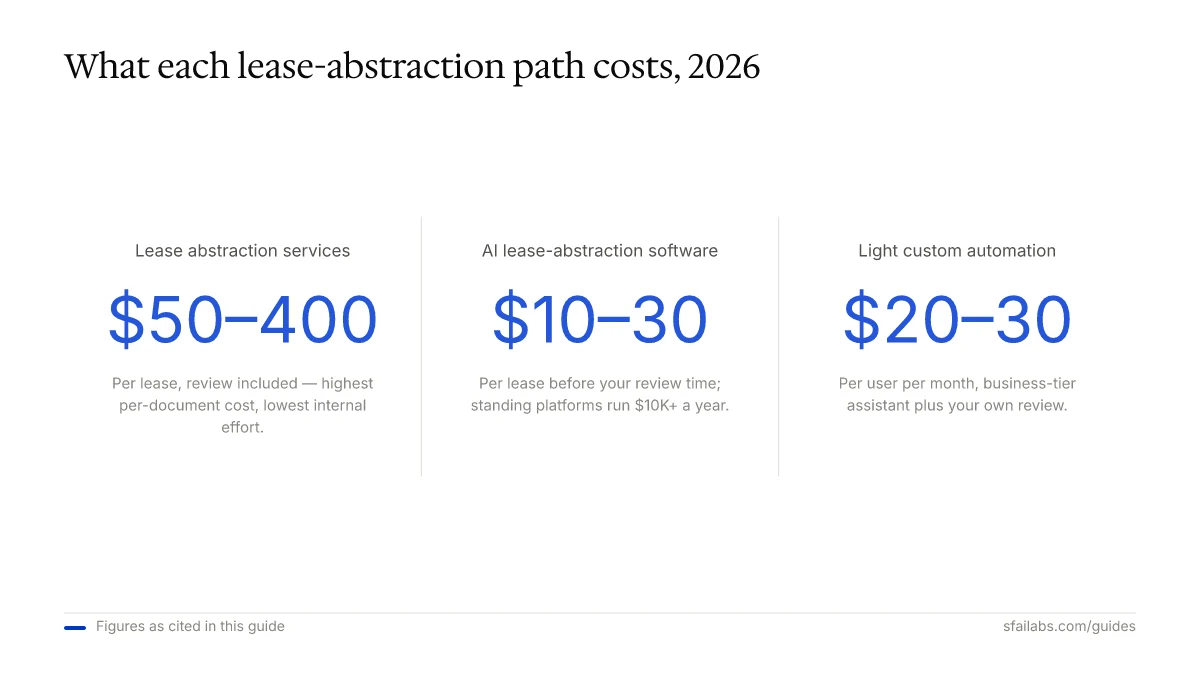
- Lease abstraction services: roughly $50–400 per lease, with US-based and legal-grade work at the top of the range and offshore volume work lower. Review is baked into the price — that is the point — which makes services the highest per-document cost and the lowest internal-effort path.
- AI software: narrow per-lease tools run about $10–30 per lease before your review time; standing platforms that bundle a lease database, alerts, and reporting run on annual contracts from roughly $10K into the five figures a year, scaling with portfolio size. Add your reviewer’s time — often the largest real line at volume.
- Custom automation: the light end is about $20–30 per user per month for a business-tier assistant plus your own review; a heavy bespoke pipeline is a project in the $25K–150K range plus ongoing maintenance, justified only above a clear volume threshold.
The math that decides it is not sticker versus sticker. It is: what does a finished, trustworthy abstract cost me today in analyst and reviewer hours, and which path removes the most of that for the least recurring spend? For a full worked breakdown of the line items, see how much automated lease abstraction actually costs. For a low-volume firm, light custom usually wins outright; for a onetime spike, a service; for a standing high-volume portfolio, a platform, with a build reserved for the outlier whose format fits nothing.
Handling confidential leases with no IT department
Leases and the financials attached to them are exactly the data you are contractually bound to protect, and a firm without an IT department can still handle all three paths responsibly with two habits.
Buy business-tier, and read the data terms. The major AI providers state that inputs on their business and enterprise plans are not used to train their models by default — verify the terms of the plan you buy, since they change, and never paste a confidential lease into a free consumer account whose terms differ. A managed service or a platform should handle this through a signed data-processing agreement and access controls; on a self-built prompt or pipeline, those guardrails are yours to set.
Classify before you send. Set a one-line internal rule for which document types are cleared for which tool or vendor, and anonymize or withhold anything under strict NDA or carrying tenant personal and financial information beyond what the task needs. The most common mistake at a small firm is an analyst sending a sensitive document to the wrong account — a simple policy prevents it, whichever of the three paths you choose.
How to choose: a 6-question filter
Run the decision through six questions before you commit a dollar.
- Is this a spike or a standing need? A onetime onboarding or a deadline backlog favors a service. A repeating monthly job favors software or a build.
- How many leases a year? A dozen points to light custom or a per-lease tool; several hundred points to a platform or a build.
- Is your required output standard or unusual? Standard fits off-the-shelf; an odd template or proprietary destination favors custom.
- Do you need to own the schema and the data? Owning it points to software you configure or a build; offloading it points to a service.
- Where does review labor sit? A service absorbs it into the price; software and custom push it back onto you — budget the hours honestly.
- What is your IT reality? No technical help caps the practical ceiling of a heavy custom build; a service or a self-serve platform needs none.
A firm that answers “spike, few hundred legacy leases, standard output, happy to offload, no IT” should buy a service. A firm that answers “standing, high volume, standard, must own the data” should buy a platform. A firm that answers “standing, modest volume, unusual output” should build light — a saved prompt into its own template — and skip the invoice entirely.
FAQ
What is the difference between lease abstraction services, AI software, and custom automation?
A service is a managed operation you hand leases to and receive finished abstracts back from — you buy the work. AI software is a tool you license and run yourself, reviewing what the model extracts — you buy the mechanism plus a review seat. Custom automation is a system built to your exact fields and workflow — you build the tool, from a light saved prompt up to a bespoke pipeline. The choice is which one to pay for, not which extracts most accurately, since all three extract standard terms at high accuracy on clean leases.
Which is cheapest for a small CRE firm?
It depends on volume and who does the reviewing. On sticker price, a service is highest per lease (roughly $50–400) because review is baked in; per-lease software is lower ($10–30) but you supply the reviewer; light custom on a business-tier assistant is close to free beyond a seat you may already have. For low volume, light custom is usually cheapest all-in; for a onetime spike, a service can beat staffing the work yourself; for standing high volume, a platform subscription often wins.
When should I use a lease abstraction service instead of software?
When abstraction is a spike rather than a habit — a portfolio onboarding, a due-diligence deadline, a backlog to clear once — and you would rather buy the finished result than license a tool and staff the review. Services also fit firms with no appetite to touch software at all, where the per-lease premium buys removed work and transferred risk. For a standing, repeating job, software or a build is usually the better long-run economics.
Is AI lease-abstraction software accurate enough to trust without review?
No, and neither is anything else without a review step. Modern extraction reaches the mid-to-high 90s on clean, digitally native leases, which still leaves a meaningful error rate on the fields that hurt most — renewal options, CAM caps, co-tenancy. Every path handles this the same way: a human approves the high-stakes fields. A service builds that review into its price; with software or custom automation, the review seat is yours to staff.
What does “custom automation” mean for a firm with no engineers?
Usually far less than a six-figure build. At the light end it is a saved, carefully engineered prompt run through a business-tier assistant — ChatGPT, Claude, or Microsoft Copilot — with a human verification pass, which needs no engineer and puts terms into your exact template. A heavy bespoke pipeline with validation and a direct write into your system of record is a real project that does need technical help; most small firms never need to go past the light end.
How much does each option cost?
Services run roughly $50–400 per lease with review included. Per-lease AI tools run about $10–30 per lease before your review time; standing platforms that bundle a database, alerts, and reporting run from about $10K into the five figures a year. Light custom is about $20–30 per user per month plus your review; a heavy custom pipeline is a $25K–150K project plus maintenance, worthwhile only at real volume. Always add internal review hours to the software and custom figures.
Can I use ChatGPT or Claude for lease abstraction instead of buying a tool?
Yes, for the extraction itself. On standard, digitally native leases, a business-tier assistant pulls structured terms at high accuracy using a well-built, reusable prompt and a human verification pass — the light end of custom automation. What it does not give you is a standing lease database, critical-date alerts, or vendor-maintained integrations, so it fits the low-to-modest-volume firm that just needs data in its own template, not the portfolio that needs a system of record.
How do I handle confidential leases safely with no IT department?
Two habits. Buy business-tier or enterprise plans and read the data terms — major providers state inputs are not used to train their models by default, but verify, since terms change, and never use a free consumer account for confidential documents. And classify before you send: a one-line rule for which document types go to which tool or vendor, with anything under strict NDA anonymized or withheld. A service or platform should sign a data-processing agreement to cover this.
How many leases a year justify building custom automation?
For a heavy pipeline, generally several hundred a year or more, so the build amortizes against per-lease fees and review time — below that, a subscription or a service is almost always the better buy. The light-custom option, though, has no real volume floor: a saved prompt into your own template pays for itself immediately at almost any volume, which is why many small firms should try it before pricing anything heavier.
Key takeaways
- The choice is procurement, not accuracy: services mean you buy the work, AI software means you buy the tool and staff the review, custom automation means you build the tool — and all three extract standard terms well on clean leases.
- Three variables decide it: annual lease volume, how standard your leases and required output are, and who has to own the schema and the process.
- Services win for spikes and total offload; software wins for standing, repeating volume that needs a queryable system of record; custom wins for unusual output or high volume — and its light end, a saved prompt, is the quiet right answer for many lean firms.
- On all-in cost, count the reviewer’s hours: a service bakes them in and prices highest per lease; software and custom push that labor back onto you.
- Whichever path you pick, handle confidential leases with business-tier accounts, signed data terms, and a classify-before-you-send rule — a firm with no IT can still do this well.
Not sure whether your firm should buy the work, buy the tool, or build a light automation of its own? That answer turns on your volume, your output format, and how much of the review you want to own — which is exactly what a short working session sorts out. Book your free AI-readiness assessment →
Arthur Wandzel