For a handful of leases, ChatGPT will read the whole document and fill in your abstract template well enough to save real time. For a portfolio, it will quietly break in ways you cannot see — a rent step misread, a clause on page 61 skipped, an output you cannot trace back to a source line. Purpose-built document AI fixes those failures, but it introduces its own: per-document pricing that punishes low volume, integration lock-in, and feature depth a 10-person firm will never touch. Neither tool is the answer. The right question is where each one breaks for your specific volume, and that is a threshold you can actually calculate. This guide names the failure points on both sides and gives you the five variables that decide it.
The short answer
Use a general assistant like ChatGPT when lease review is occasional, low-volume, and one person checks every extracted field against the source document. Move to purpose-built document AI when abstraction becomes a recurring, multi-lease workflow that has to feed a rent roll or accounting system, survive an audit, or track amendments across a stack. The dividing line is not accuracy on a single well-formatted lease — both handle that. It is consistency at volume, traceability, and integration, which is exactly what a general chatbot was never built to guarantee.
For most 4–20 person firms, the honest starting point is a business-tier general assistant plus a disciplined template. You graduate to a dedicated platform when the volume math flips, not because a vendor blog told you ChatGPT “doesn’t cut it.”
What each tool actually is
These are two different categories of software, and the comparison only makes sense once that is clear.
ChatGPT is a general-purpose language model. You paste or upload a lease, describe the fields you want, and it returns them as text. It has no fixed schema, no memory of the last lease you ran, and no built-in link between an answer and the line it came from. It is a brilliant reader and a forgetful clerk.
Purpose-built document AI is a pipeline, not a chat window. Tools such as Prophia, Leasecake, and dedicated abstraction engines like Kira sit on top of a defined data model. They apply optical character recognition, extract a fixed set of commercial lease fields — base rent, commencement and expiration dates, options, escalations, recovery terms — score their own confidence, flag low-confidence fields for review, link every value back to the source clause, and export structured data into your property management stack. Leading platforms are trained to recognize on the order of a thousand distinct provision types, and report accuracy in the low-to-mid 90s on standard commercial terms (The AI Consulting Network; Kolena). The tradeoff for that structure is cost, setup, and rigidity.
The full landscape of these systems — from consumer chatbots to custom extraction pipelines — is mapped in our commercial real estate document intelligence guide. This article is about the fault lines between the two most common choices a small firm weighs.
Where ChatGPT breaks for lease review
A general assistant fails in specific, predictable ways once you push past a few documents. Vendor marketing overstates these to sell the alternative, but the failure modes are real.
It hallucinates confidently. A language model can return a rent figure, a date, or a clause summary that reads as authoritative and is simply wrong. On a lease, a plausible-but-invented commencement date is worse than an obvious error, because nobody double-checks the confident answer. Purpose-built tools counter this with multi-stage validation and confidence scoring; a general chat has neither (Prophia).
It truncates long documents. A 90-page ground lease with amendments can exceed what the model reliably holds in working context. Provisions buried deep in the document — a co-tenancy clause, a late option notice window — get dropped silently. You do not get a warning; you get an abstract that looks complete and is not.
It gives you no audit trail. The extracted value floats free of the source. When a lender or a partner asks “where does this expiration date come from,” you cannot click through to the clause. For due-diligence work, that missing link is disqualifying on its own.
It is inconsistent across documents. Run the same template over ten leases and you get ten slightly different interpretations of “what counts as base rent.” There is no enforced schema, so the output drifts. Rekeying that into a spreadsheet reintroduces the manual error the tool was supposed to remove.
It does not connect to anything. A chat response is not a data feed. You cannot push it into Yardi, AppFolio, or a rent roll without a human copying fields across. At one or two leases that is fine. At fifty it is the whole job again.
Where purpose-built document AI breaks
The vendor-authored side of the internet stops here, because this is where their product looks weakest. For a small firm, these failures matter as much as ChatGPT’s.
Per-document and enterprise pricing punishes low volume. Dedicated abstraction platforms often price per document processed or by annual contract, with serious document-intelligence engines starting in the low thousands of dollars a month. If you abstract fifteen leases a year, that is a wildly expensive way to save fifteen afternoons. The unit economics only work above a volume threshold most small firms never reach.
Setup and integration are real projects. Connecting a platform to your systems, mapping its schema to your fields, and training the team is not a same-day task. A firm without an IT department can spend more in staff time standing the tool up than it saves in the first year.
Feature depth becomes overkill. A platform built for a 5,000-lease institutional portfolio carries abstraction-review queues, portfolio dashboards, and governance controls a 10-person shop will never open. You pay for that surface area whether or not you use it.
Lock-in is a genuine cost. Once your lease data lives inside a proprietary platform, leaving it means an export-and-migration project. That switching cost is easy to ignore at signup and painful at renewal. We work through this specific tradeoff in our comparison of Prophia versus a custom-built approach for a 10-person firm, and the broader build decision in our off-the-shelf versus custom document AI framework.
The five variables that actually decide it
Ignore brand loyalty. Five variables predict which tool fits, and you can score your own firm on each in about two minutes.
| Variable | Points to ChatGPT | Points to purpose-built |
|---|---|---|
| Volume | A handful of leases a year | Recurring, dozens-plus, batch work |
| Integration | Output lives in a doc or spreadsheet | Data must feed a rent roll or accounting system |
| Auditability | Internal use, no third-party scrutiny | Lender, investor, or diligence review |
| Amendment complexity | Clean single-document leases | Heavily amended stacks, estoppels, master-lease chains |
| Data sensitivity | Handled with business-tier terms | Requires vendor data-handling guarantees |
Count where you land. Three or more on the right and a general assistant will keep costing you in silent errors and rekeying. Three or more on the left and a platform contract is a solution to a problem you do not have. The point is that this is a volume-and-workflow decision, not a quality contest between two brand names.
Accuracy and the human in the loop
The most important thing to understand about accuracy is that neither tool removes the reviewer. Purpose-built platforms report accuracy in the low-to-mid 90s on standard lease terms and cut per-lease review time from several hours to well under one (Kolena). That is a real gain — and it still means several fields per lease need human confirmation, and heavily amended or oddly formatted documents trip up automated extraction entirely.
A general assistant has no confidence score at all, so the human check is not optional — it is the control. The reliable pattern, whichever tool you use, is the same one the credible vendors describe: let the AI do the first pass, then have a person verify the high-stakes fields — critical dates, rent, options, recovery terms — against the source clause before anything is trusted (Lextract). The difference is that a purpose-built tool tells you which fields to doubt; a chatbot makes you doubt all of them equally.
This is why the “AI replaces the analyst” framing is wrong for lease work. The AI replaces the typing, not the judgment.
What each option costs
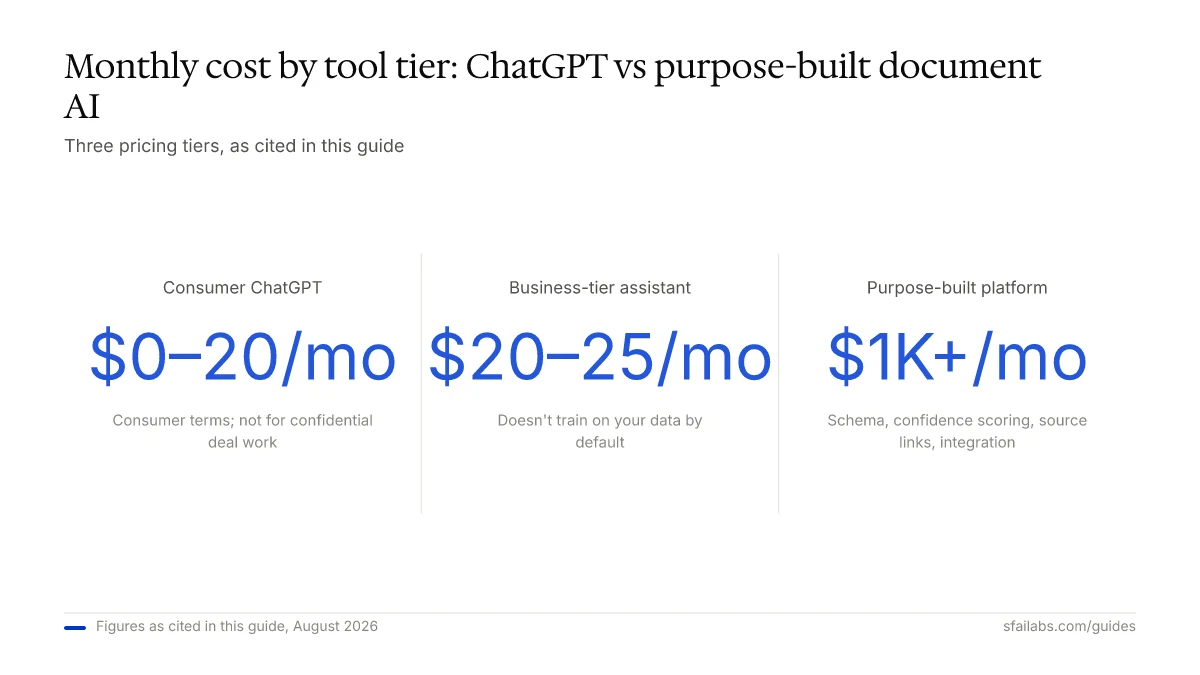
Costs live in different units, which is what makes the comparison confusing. Here is the honest shape of each, in market ranges rather than any single vendor’s list price.
| Option | Typical cost | What you actually pay for |
|---|---|---|
| Consumer ChatGPT | Free to ~$20/user/month | A capable reader with consumer data terms — not for confidential deal work |
| Business-tier assistant (ChatGPT Business, Claude Team) | ~$20–25/user/month | Same capability plus terms that keep your data out of model training |
| Purpose-built abstraction platform | Low thousands/month or per-document contract | Schema, confidence scoring, source links, batch processing, integration |
| Custom extraction pipeline | Project-based build | A pipeline shaped to your exact fields and systems, owned by you |
The subscription cost is rarely the deciding number. Staff time is. A business-tier assistant at roughly $250 a year per person plus disciplined review can cover a firm doing occasional lease work for a fraction of a platform contract. A platform earns its keep when volume is high enough that the hours saved dwarf the fee — the crossover point most small firms misjudge. We put concrete numbers on that crossover in our breakdown of what automated lease abstraction actually costs in 2026.
The confidential-data question
This is the failure mode most roundups skip, and it applies to ChatGPT specifically. On the consumer tier, prompts are used to train the model by default unless you find and toggle the opt-out. Pasting a confidential lease, an LOI, or a rent roll into a free or Plus account means handing deal terms to a general training process (OpenAI enterprise privacy).
The fix is not to avoid the tool — it is to buy the right tier. ChatGPT Business, Enterprise, Team, and the API do not train on your data by default. Purpose-built platforms carry their own data-handling and retention terms built for regulated document work. The practical rule for a firm handling confidential deal data: never run it through a consumer chat account, and read the data terms before you upload anything sensitive to any tool. That single distinction — consumer versus business terms — is more consequential than the choice between brands.
The threshold: when a small firm should switch
Put the pieces together and the decision resolves cleanly. Start with a business-tier general assistant and a solid abstract template when your lease work is occasional, internal, and you have someone to verify every field. That covers a large share of 4–20 person firms and costs almost nothing to run.
Switch to purpose-built document AI when three things become true at once: abstraction is a recurring workflow measured in dozens of leases, the output has to flow into a rent roll or accounting system without rekeying, and third parties will scrutinize the numbers. At that point the general assistant’s silent errors and manual handoffs cost more than the platform fee, and the structure pays for itself. A lean firm’s real advantage is that it can make this switch in weeks, not quarters — the same structural speed we argue for across the board in the small CRE firm AI manifesto. For a survey of the specific tools worth shortlisting at that stage, see our roundup of the best AI lease abstraction tools for small CRE firms.
The industry backdrop supports patience over panic. Deloitte’s 2026 Commercial Real Estate Outlook, drawn from more than 850 executives across 13 countries, treats AI literacy as a board-level priority rather than a single-tool purchase. JLL’s 2025 technology survey found most CRE firms piloting AI but few hitting all their program goals — the gap is disciplined process, not a better chatbot. Choose the tool that matches your volume, keep a human on the critical fields, and you will outperform firms that bought a platform they were too small to fill.
FAQ
Can ChatGPT abstract a commercial lease accurately?
For a single, cleanly formatted lease, yes — a business-tier assistant can read the full document and populate your template with real time savings. The reliability caveat is that it has no confidence score and no source link, so a person has to verify every high-stakes field against the source clause. It becomes unreliable at volume, where inconsistent interpretation and silent omissions on long documents accumulate.
Is it safe to upload a confidential lease to ChatGPT?
Not on a free or consumer Plus account, where prompts are used for model training by default. Use ChatGPT Business, Enterprise, or Team, which do not train on your data by default, or a purpose-built platform with explicit data-handling terms. For any tool, read the data terms before uploading confidential deal documents.
What is purpose-built document AI for lease abstraction?
It is software built specifically to extract a fixed set of commercial lease fields into structured data. Unlike a general chatbot, it applies a defined schema, scores its confidence per field, links each value to the source clause, processes documents in batches, and exports into property management or accounting systems. Prophia, Leasecake, and dedicated abstraction engines are examples.
How accurate is AI lease abstraction?
Leading purpose-built platforms report accuracy in the low-to-mid 90s on standard commercial lease terms, and cut per-lease time from several hours to well under one. Accuracy drops on heavily amended, scanned, or unusually formatted leases. In every credible workflow a human verifies the critical fields — dates, rent, options — before the data is trusted.
ChatGPT or a platform like Prophia for a 10-person firm?
It depends on volume and integration need, not firm size alone. If lease review is occasional and stays in a spreadsheet, a business-tier assistant is enough. If you abstract dozens of leases that must feed a rent roll and survive lender scrutiny, a platform is worth it. Many 10-person firms sit on the assistant side longer than vendors suggest.
How much cheaper is ChatGPT than purpose-built lease software?
A business-tier assistant runs about $20–25 per user per month. Purpose-built platforms are priced per document or by annual contract, often in the low thousands of dollars a month. The gap is large, but so is the capability difference — the real comparison is platform fee versus the staff hours a general assistant leaves on the table at your volume.
When does a small CRE firm outgrow ChatGPT for lease review?
When three conditions arrive together: abstraction becomes a recurring, dozens-plus workflow; the output must flow into another system without rekeying; and third parties audit the numbers. Below that threshold, a platform is overkill. Above it, the general assistant’s manual handoffs and silent errors cost more than the subscription.
Does AI lease abstraction still need a human reviewer?
Yes, always. Purpose-built tools reduce the review burden by flagging low-confidence fields, but a person still confirms critical dates, rent, and options against the source. A general assistant needs even closer review because it offers no confidence signal. The AI removes the typing, not the professional judgment.
Can ChatGPT handle amended leases and estoppels?
Poorly, once the stack gets complex. Linking an amendment back to the master lease, reconciling conflicting terms, and tracking option deadlines across documents is exactly the structured work a general chat is weakest at. Purpose-built tools that maintain amendment chains handle this far more reliably, though even they need human confirmation on tangled stacks.
Will ChatGPT miss clauses in a very long lease?
It can. Long ground leases with amendments may exceed what the model reliably processes in one pass, and buried provisions get dropped without any warning. If your leases routinely run long or arrive as multi-document stacks, that silent-omission risk is a strong signal to use a tool built for systematic extraction.
Key takeaways
- ChatGPT reads a single lease well but breaks at volume — no confidence scoring, no source links, no integration, and silent omissions on long documents.
- Purpose-built document AI fixes those failures but breaks on small-firm economics — per-document pricing, setup overhead, feature overkill, and lock-in.
- Five variables decide it: volume, integration need, auditability, amendment complexity, and data sensitivity. Score your firm before you buy.
- Neither tool removes the human reviewer; both require verifying critical fields — dates, rent, options — against the source clause.
- Never run confidential deal documents through a consumer chat account; use a business tier or a platform with explicit data terms.
Not sure which side of the threshold your firm sits on? A short, free AI-readiness assessment will map your lease volume, systems, and data-handling needs and tell you exactly which tool earns its cost. Book your free AI-readiness assessment → and we will size it for your firm.
Dirk Jan van Veen, PhD