Many organizations appoint a Chief AI Officer and then hand them a list of AI pilot projects with no budget authority and no clear mandate. The role exists on paper; the power doesn’t. IBM’s Institute for Business Value found that 26% of companies had a dedicated CAIO by 2025, up from 11% in 2023. What that adoption curve doesn’t show is how many of those appointments are largely symbolic.
A CAIO who works — who moves the organization forward on AI — does three things the job description usually doesn’t say explicitly: controls resource allocation, enforces governance, and translates AI capabilities into language the board will fund. Everything else follows from those three.
What a Chief AI Officer Does in Practice
The formal job description lists strategy, ethics, talent, and cross-functional collaboration. Those are accurate but abstract. In practice, a CAIO runs an operating system for AI decisions: what gets built, what gets bought, what gets stopped, and who is accountable for each.
Building and managing the AI portfolio
A CAIO sets the portfolio of AI initiatives, not just the roadmap. That means choosing which projects to scale, which to keep as experiments, and which to kill, and having the standing to enforce those decisions without deferring to individual business unit heads. Without that authority, AI ends up as a collection of disconnected proofs-of-concept, each owned by whoever has the loudest sponsor.
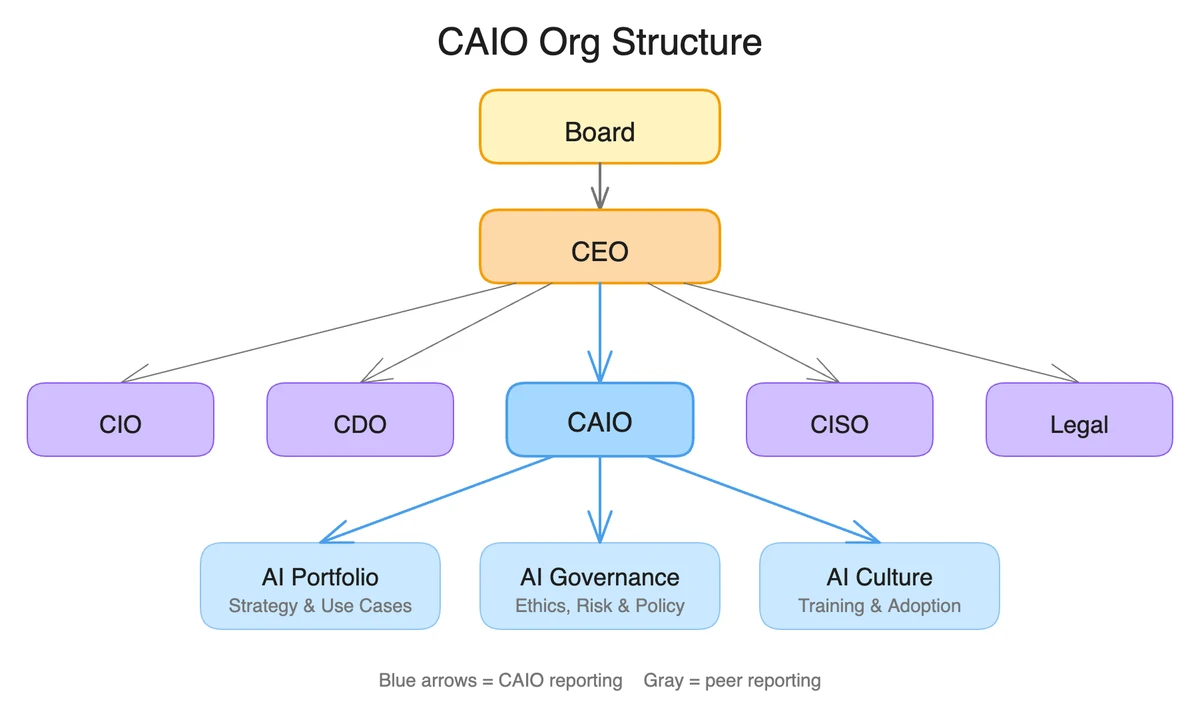
The CAIO coordinates with the CIO on platforms, the CDO on data infrastructure, the CISO on security guardrails, and Legal on regulatory exposure. Those are not soft “stakeholder relationships.” They are hard dependencies. An AI initiative that Legal hasn’t reviewed ships late, or doesn’t ship.
Owning governance before a regulator forces it
The EU AI Act’s prohibitions took effect February 2, 2025. U.S. federal agencies were required to designate a CAIO under OMB Memorandum M-24-10. These are active requirements, not horizon items, and every enterprise operating in regulated markets is already subject to some version of this pressure.
Governance is where many CAIOs underinvest early. The instinct is to focus on building and shipping. But a CAIO who arrives at the board six months in without an AI risk register, documented vendor practices, and a model monitoring framework will have a bad quarter when something goes wrong. Governance built proactively takes less time than governance built reactively after an incident. A practical starting point is building an AI governance framework before the first major deployment.
Reporting AI performance in business terms
CAIOs report AI performance to CEOs and boards. That requires a scorecard that speaks business language, not model metrics. Accuracy percentages and F1 scores don’t move boardroom conversations. Revenue attribution, cost reduction per automated process, and cycle time improvement do.
A practical approach: one-page AI performance summary updated monthly, covering three to five initiatives, each with a baseline, current metric, and trend. Boards will fund what they can see working. For help quantifying the business case, the AI ROI calculator for enterprise teams provides a structured baseline framework.
The Skills That Separate Good CAIOs from Great Ones
IDC’s research, drawn from CAIO Summit interviews, identifies seven core competencies: AI technology proficiency (LLMs, RAG architectures, classical ML), data science fundamentals, risk management, strategic vision, ethical AI knowledge, growth mindset, and project management. That list is accurate but incomplete.
The CAIOs who drive real organizational change hold technical credibility and business authority simultaneously. They can sit in a model review, ask the right questions about training data quality, and then walk into a board presentation to explain why that data quality issue represents a $3M revenue risk. Most executives can do one or the other. A CAIO needs both in most leadership conversations.
The other underrated trait is patience. AI transformation typically runs longer than executives expect, often two to three years before foundational infrastructure, governance, and team capability are all in place. CAIOs who chase visible wins at the expense of foundational work (data infrastructure, governance, team capability) tend to peak early and stall. The role rewards consistent execution over visible heroics.
When Your Organization Needs a CAIO
Not every organization does. For companies still running a single AI project, or where AI hasn’t yet touched multiple business functions, a senior AI lead reporting to the CTO or CDO often achieves the same accountability at lower organizational cost. The AI strategy vs. implementation decision goes deeper on when to build internal AI leadership vs. rely on an agency model. The dedicated CAIO role justifies itself when AI is embedded across multiple product lines or operational functions, when regulatory exposure requires a named executive accountable for AI risk, or when the board is actively asking about AI ROI and no one in current leadership can answer clearly.
The better question isn’t “do we need a CAIO?” but “who in our leadership is accountable for AI outcomes across the whole company?” If the answer is “everyone, which means no one” — that’s the gap the CAIO role fills. Appointing someone without fixing that accountability structure first produces a frustrated executive and no better outcomes.
Frequently Asked Questions
What does a Chief AI Officer do day to day?
A CAIO manages the company’s AI portfolio, runs governance processes to assess risk and compliance, and reports AI performance to leadership. In practice, this involves reviewing initiative roadmaps, working with legal and engineering on compliance requirements, evaluating vendors, and preparing board-facing metrics. The role is part portfolio manager, part risk officer, and part internal consultant, often all three in the same week.
How is a CAIO different from a CIO or CDO?
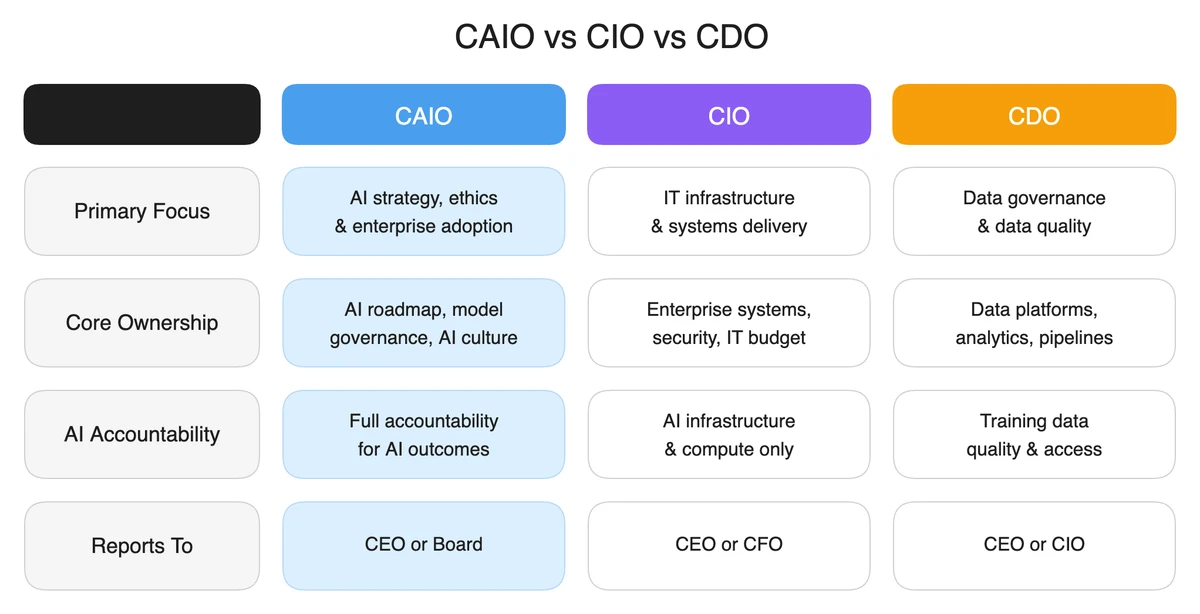
The CIO owns IT infrastructure and platforms. The CDO owns data assets and data strategy. The CAIO owns AI strategy, the AI initiative portfolio, and accountability for AI outcomes including ethical and regulatory ones. In practice, the CAIO depends heavily on the CIO for infrastructure and the CDO for data quality; those three roles form the core AI leadership team in most enterprises.
What does a Chief AI Officer earn?
Glassdoor puts the U.S. average at approximately $354,000, with top earners above $500,000. Fortune 500 total compensation packages including equity and bonus typically land in the $350,000–$650,000 range. The spread is wide because the scope varies significantly: a CAIO at a 200-person startup overseeing two AI products and a CAIO at a global bank governing dozens of deployed models are doing fundamentally different jobs.
When should a company hire a Chief AI Officer?
When AI runs across multiple business units and no single executive has clear accountability for outcomes. That’s the clearest signal. Other triggers: active regulatory requirements (EU AI Act compliance, sector-specific mandates), board pressure to demonstrate AI ROI, or repeated failure to move AI initiatives from pilot to production. One thing to get right before hiring: ensure the role has real budget and portfolio authority. A CAIO without those is an expensive analyst.
What should a new CAIO do first?
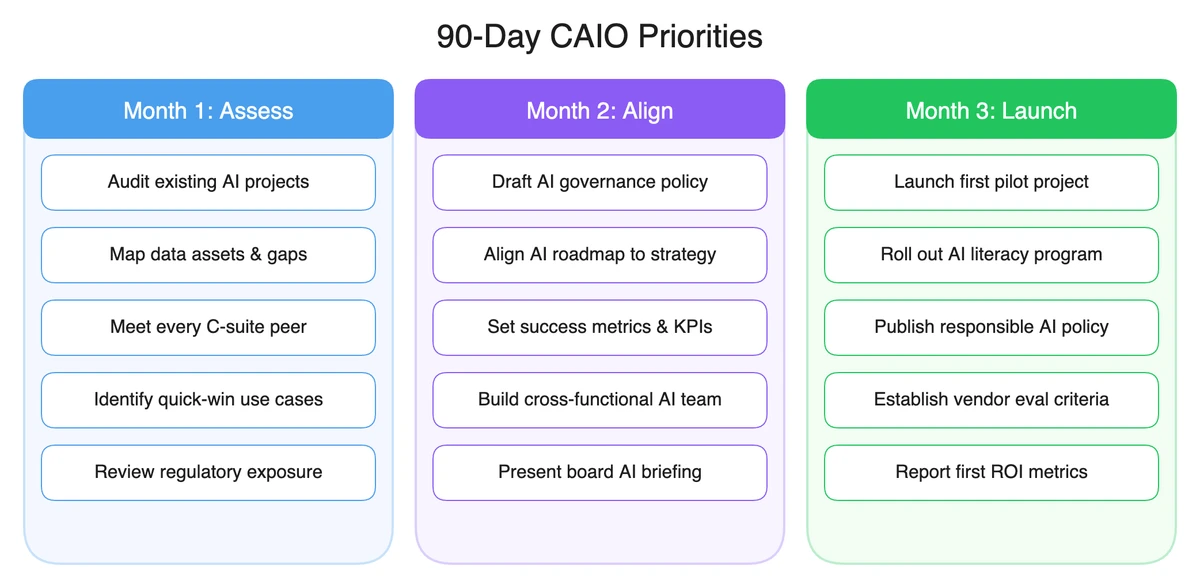
Map every active AI initiative, document what governance exists, and identify the three initiatives with the clearest path to measurable ROI. Don’t reorganize teams or launch new projects in the first quarter. The first 90 days are an intelligence-gathering and trust-building exercise. A CAIO who delivers a governance baseline and a prioritized portfolio within the first quarter has the credibility to make harder calls in months four and five.
Key Takeaways
- A CAIO without budget authority and portfolio control is a figurehead. Structure the governance and reporting lines before making the appointment.
- Governance built proactively (risk registers, vendor documentation, model monitoring) costs less than governance built after something goes wrong.
- The defining CAIO skill is holding technical credibility and business authority simultaneously, not being the best at either alone.
- Organizations running a single AI project or where AI hasn’t yet touched multiple business functions likely don’t need a dedicated CAIO; a senior AI lead under the CTO or CDO achieves the same accountability at lower overhead.
- Measure AI performance in business terms: revenue attribution, cost reduction, and cycle time, not model accuracy metrics.
SFAI Labs