Quick take: LangChain leads for most startups building LLM applications, offering the fastest path from prototype to production with extensive integrations and strong community support. For deep learning projects requiring custom models, PyTorch provides the flexibility you need without the steep learning curve of lower-level frameworks.
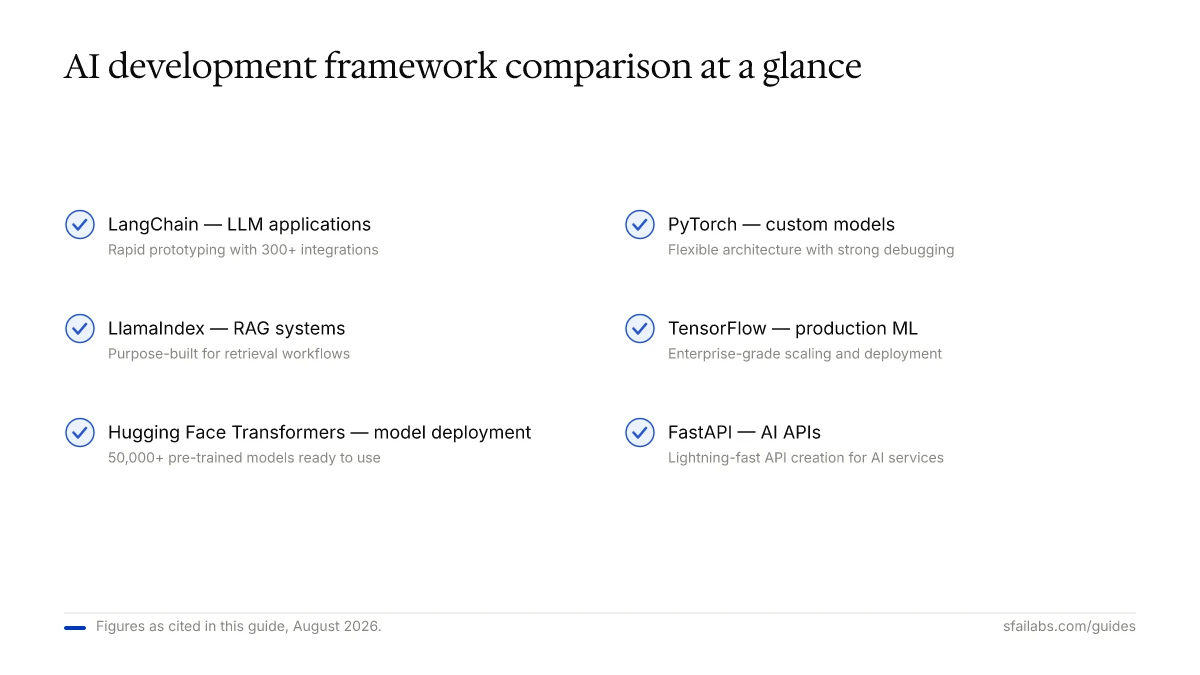
Framework Comparison
| Framework | Best For | Key Strength |
|---|---|---|
| LangChain | LLM applications | Rapid prototyping with 300+ integrations |
| LlamaIndex | RAG systems | Purpose-built for retrieval workflows |
| Hugging Face Transformers | Model deployment | 50,000+ pre-trained models ready to use |
| PyTorch | Custom models | Flexible architecture with strong debugging |
| TensorFlow | Production ML | Enterprise-grade scaling and deployment |
| FastAPI | AI APIs | Lightning-fast API creation for AI services |
1. LangChain
LangChain has become the de facto standard for building LLM applications. The framework provides pre-built chains for common patterns like chatbots, document Q&A, and agent workflows. You can connect to OpenAI, Anthropic, or open-source models with minimal code changes.
The real value is in the ecosystem. LangChain integrates with 300+ vector databases, document loaders, and APIs out of the box. This means you spend less time on infrastructure and more time on your product’s unique features. The LangSmith debugging platform helps you trace issues through complex multi-step chains, which becomes critical as your application grows.
Startups choose LangChain when they need to ship fast. The learning curve is manageable for developers familiar with Python, and the documentation includes production patterns. The main limitation is abstraction overhead—if you need fine-grained control over model behavior, you might fight the framework’s opinions.
2. LlamaIndex
LlamaIndex specializes in retrieval-augmented generation (RAG). If your product involves querying documents, knowledge bases, or private data, this framework handles the complexity of chunking, embedding, and retrieval better than general-purpose tools.
The framework provides optimized data connectors for 160+ sources including Notion, Slack, Google Drive, and databases. It automatically handles document preprocessing, metadata extraction, and index optimization. Query engines support hybrid search, reranking, and citation tracking without manual configuration.
Choose LlamaIndex when retrieval quality directly impacts your product value. The framework’s focus means better out-of-the-box performance for RAG use cases compared to building from scratch. The tradeoff is less flexibility for non-retrieval workflows—if your application needs diverse AI capabilities, LangChain’s broader scope might serve you better.
3. Hugging Face Transformers
Hugging Face Transformers gives you access to 50,000+ pre-trained models with a consistent API. Whether you need text generation, image classification, or speech recognition, you can test a state-of-the-art model in under 10 lines of code.
The Hub ecosystem lets you fine-tune models on your data, then deploy them with Inference Endpoints. Startups use this to validate AI capabilities before investing in custom infrastructure. The library handles tokenization, model loading, and inference optimization automatically, which eliminates common implementation errors.
This framework works when you need proven models fast. The community contributions mean you can find models for niche tasks like legal document classification or medical image analysis. The limitation is customization—while you can fine-tune models, building novel architectures requires dropping down to PyTorch or TensorFlow.
4. PyTorch
PyTorch provides low-level control for teams building custom models or research-driven products. The framework’s dynamic computation graph makes debugging feel like normal Python development. You can inspect tensors at any point, which dramatically speeds up development compared to static graph frameworks.
The ecosystem includes TorchServe for model deployment, PyTorch Lightning for reducing boilerplate, and a massive collection of community implementations. Major AI labs publish research code in PyTorch, so you can replicate cutting-edge techniques quickly. The learning resources are exceptional—fast.ai built their entire course around PyTorch’s design philosophy.
Startups choose PyTorch when they need to differentiate through novel model architectures or when existing frameworks don’t support their use case. The tradeoff is development time—you handle more implementation details compared to high-level frameworks. If your competitive advantage comes from unique AI capabilities rather than application features, this investment pays off.
5. TensorFlow
TensorFlow excels at production deployment and scaling. The framework’s tight integration with Google Cloud, TensorFlow Serving, and TFX (TensorFlow Extended) provides battle-tested patterns for enterprise ML systems. Teams use TensorFlow when reliability and performance matter more than development speed.
TensorFlow Lite and TensorFlow.js extend your models to mobile and web platforms with optimization for resource-constrained environments. The SavedModel format ensures your trained models work across serving infrastructure without modification. For edge deployment scenarios, TensorFlow’s tooling is more mature than alternatives.
Choose TensorFlow when you know your AI system will need to scale to millions of users or run on diverse hardware. The framework handles distributed training, model versioning, and A/B testing through its ecosystem. The learning curve is steeper than PyTorch, and rapid experimentation feels slower due to the static graph model.
6. FastAPI
FastAPI isn’t an AI framework, but it’s the fastest way to wrap your AI models in production APIs. The framework generates OpenAPI documentation automatically, validates request/response schemas with Pydantic, and handles async requests efficiently. Startups use FastAPI to expose their AI capabilities to frontend applications or external integrations.
The async support means you can handle multiple inference requests concurrently without blocking. This matters when your model takes seconds to generate responses. FastAPI’s dependency injection system makes it simple to manage model loading, caching, and monitoring. The framework works seamlessly with PyTorch, TensorFlow, and Hugging Face models.
FastAPI is the bridge between your AI development and your product. Combined with any of the above frameworks, it provides the API layer your application needs. The main consideration is operational complexity—you’ll need to handle model versioning, load balancing, and error recovery yourself.
How We Chose These Frameworks
We evaluated frameworks based on startup-specific criteria: time to first working prototype, community support for troubleshooting, production deployment patterns, and cost of switching later. We prioritized frameworks with active development and strong adoption in the startup ecosystem. Frameworks were tested with common startup use cases including chatbots, document analysis, and API services.
Frequently Asked Questions
Which framework should I learn first? Start with LangChain if you’re building LLM applications or PyTorch if you need custom models. Both have extensive tutorials and active communities. You can learn either in 2-3 weeks of focused practice.
Can I use multiple frameworks together? Yes, and many startups do. LangChain for orchestration + Hugging Face for models + FastAPI for serving is a common stack. The frameworks complement rather than compete with each other.
What if I choose the wrong framework? Most frameworks share similar concepts, so switching costs are lower than expected. The bigger risk is building without a framework—you’ll recreate solved problems. Start with something rather than optimizing the choice.
Do I need a framework or can I use OpenAI directly? For single-prompt applications, direct API calls work fine. Once you add context management, tool usage, or multi-step workflows, frameworks save significant development time.
How much does framework choice affect hiring? PyTorch and TensorFlow skills are common among AI engineers. LangChain is newer but growing fast. Any experienced developer can learn these frameworks in weeks, so optimize for your product needs rather than the hiring market.
Key Takeaways
- LangChain provides the fastest path to production for LLM applications with extensive integrations
- LlamaIndex specializes in RAG systems and delivers better retrieval quality out of the box
- Hugging Face Transformers offers 50,000+ pre-trained models for rapid capability testing
- PyTorch gives you flexibility for custom model development with excellent debugging
- TensorFlow excels at enterprise-scale deployment across diverse infrastructure
- FastAPI wraps any framework’s models in production-ready APIs with minimal code
SFAI Labs helps founders choose and implement the right AI stack for their product vision. We provide technical architecture reviews, framework selection guidance, and hands-on development support. Schedule a free 30-minute consultation to discuss your AI development strategy.
SFAI Labs