The best AI deal screening tool for a 4-20 person CRE investment firm is almost never the most expensive one or the one with the longest feature list. It is the tool that matches your deal volume, that a non-technical principal can run without an integration project, and that you trust enough to act on. For most small shops that means starting with a general AI assistant and a written buy box, then adding a purpose-built platform only when volume makes the manual version hurt. This guide sorts the market into four tiers by the job each tool does in the screening funnel, names the real products, and is blunt about where each one breaks.
What “Deal Screening” Actually Requires
Screening is not one task. It is four, and most tools are strong at one or two of them. Before you compare products, separate the jobs:
- Triage. Read every inbound broker blast, listing alert, and off-market teaser and decide, fast, whether it fits your buy box at all.
- Extraction. Pull the real numbers (rents, expenses, NOI, unit mix, lease terms) out of the OM, T-12, and rent roll into a structured format you can work with.
- Comps. Find and defend the rent and sale comparables that anchor your value.
- Scoring and ranking. Turn survivors into a ranked shortlist so the best deal gets underwritten first, not the one that shouted loudest.
A tool that nails triage may do nothing for comps, and a comps platform does not read your inbox. The mistake small firms make is buying one product and expecting it to close all four gaps. Match the tool to the job.
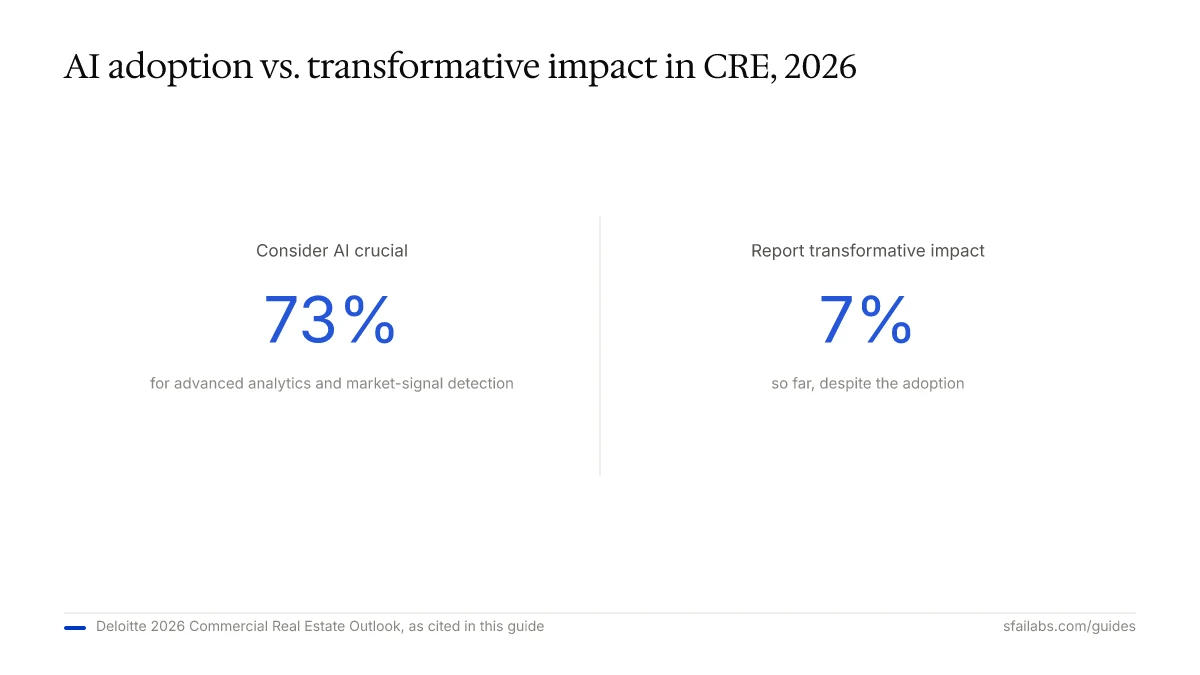
Deloitte’s 2026 commercial real estate outlook found that 73% of CRE firms now consider AI crucial for advanced analytics and market-signal detection, while only 7% report transformative impact so far. That gap is the story of this market: plenty of tools, far fewer firms with a workflow that uses them well.
Tier 1 — General AI Assistants (ChatGPT, Claude, Gemini)
For a firm screening anywhere from a handful to a few dozen deals a week, a business-tier subscription to ChatGPT, Claude, or Gemini is the highest-return first purchase. Paired with a written buy box, a general assistant reads an OM, extracts the numbers into a table, drafts a first-pass screen against your criteria, and writes the “here is why we passed” note in seconds. It costs tens of dollars per seat per month and requires zero integration.
Our recommendation for most small shops: pick one and standardize on it. ChatGPT and Claude are both strong at document reading and structured extraction; the practical difference is which one your team will open every morning and which handles your document formats more cleanly in your own testing. Gemini is a reasonable third if your firm lives in Google Workspace, and Microsoft Copilot fits firms on Microsoft 365 that want AI inside Excel and Outlook where the work already happens.
Where general assistants break: they have no persistent deal database, so you re-upload documents every time; they hold no live market data, so they cannot pull a real comp; and at high volume, the manual copy-paste rhythm becomes the bottleneck you were trying to remove. Those breaking points are the signal that you have outgrown the first tier and a paid platform may be worth it. We walk through the full daily workflow in our deal analysis playbook.
Tier 2 — Purpose-Built Deal Triage and Scoring
Purpose-built platforms solve the two things a general assistant cannot: memory and volume. You encode your buy box once, connect an inbox or upload a batch, and the tool emits a verdict and a mandate-fit score on every deal so your shortlist builds itself.
Dealpath is the most established name here. Its Dealpath AI layer, announced in 2026, bundles AI Deal Screening (which converts document review into a tear sheet with a portfolio-fit summary), AI Comps, AI Extract, and an AI Excel Assistant that connects the platform to Excel through the ChatGPT and Claude add-ins. Dealpath’s public materials claim its extraction reads OMs and flyers “in under a minute with 95% accuracy.” Read that as a vendor figure, not an independent benchmark: accuracy depends on whether your documents are clean digital PDFs or scanned faxes, so test it on your own deal flow before trusting any single number.
Newer entrants (Siftt.AI, Blooma, Reonomy and similar acquisitions-focused tools) lean into the triage-and-score job: encode the buy box, then tag each inbound deal with a verdict like kill, watch, pursue, or priority plus a 0-100 fit score. For a firm drowning in broker-blast volume, that ranked inbox is the entire value proposition.
The honest question is whether you need this yet. If you screen 50-plus deals a month and a person is spending real hours triaging, the subscription pays for itself. If you screen a dozen, a general assistant and discipline get you most of the way for far less. The choice between renting one of these and commissioning something built for your exact pipeline is worth its own analysis, which we lay out in Dealpath vs. custom deal pipeline automation.
Tier 3 — Market Data and Comps (CoStar, Crexi, HelloData)
No AI tool invents a comp. Comps come from data, and the data layer is where a lot of screening quality lives. Three products cover most of what a small firm needs, at very different price points.
CoStar remains the system of record for US commercial real estate: the broadest dataset for sale and lease comparables, tenant and ownership data, availability, and submarket analytics. It is the expensive option and the one most firms open first when a deal gets serious.
Crexi Intelligence is the lighter-weight alternative built into a marketplace many brokers already use, surfacing nearby rent comps, heat maps, neighborhood benchmarks, and exportable reports without a full enterprise data contract.
HelloData is the specialist. It automates multifamily rent comps, pricing and concession data, and property-condition scoring by surveying tens of millions of units daily, priced as a lower-cost alternative to the incumbents at roughly a few hundred dollars a month. If you buy multifamily, it does one job exceptionally well.
The pattern to notice: these tools feed the AI tools. A general assistant or a triage platform is far more useful when you hand it a real comp set from CoStar, Crexi, or HelloData than when you ask a language model to recall one from memory, which it cannot reliably do. Buy data for the asset class you transact in, and resist paying for the broadest dataset before your volume justifies it.
Tier 4 — Custom Automation
At some point a firm’s workflow becomes specific enough that renting five overlapping tools is more expensive and more brittle than commissioning one pipeline built for it. A custom automation watches your inbox, extracts every OM and T-12 into your standard model, scores against your exact buy box, and drops a ranked shortlist into the tool your team already uses.
This makes sense when three things are true at once: deal volume is high enough that seat-based pricing is climbing, your workflow has quirks no off-the-shelf tool matches (a niche asset class, a proprietary scoring model, an unusual data source), and you have documented that workflow well enough to hand to a builder. In the current market these projects run roughly $25K to $150K depending on scope, so the volume and the pain both have to be real. Most 4-20 person firms are not there on day one. The decision framework is covered in Dealpath vs. custom deal pipeline automation.
How to Choose: A Five-Question Filter
Ignore the feature grids and answer five questions:
- How many deals do you screen a week? Under roughly a dozen, stay in Tier 1. Fifty-plus, a purpose-built platform earns its keep.
- Who runs the tool? If it is a principal with no technical support, weight heavily toward tools that work out of the box.
- What asset class? Multifamily rent comps, retail lease comps, and industrial data are different products. Buy the data layer for what you transact.
- Where does your screening break today? Triage, extraction, comps, or ranking? Buy for the broken job, not the whole category.
- Can you describe your buy box in writing? If not, no tool will screen well, because you have not defined what a good deal looks like. Fix that first, at zero cost. It is the cheapest, highest-return step here, and the one every vendor demo skips because it does not sell software.
The Verification Protocol No Vendor Sells You
Every tool in this guide produces output that looks authoritative and is sometimes wrong. The failure mode is not a tool that visibly crashes; it is a clean-looking number that is silently off, usually because a scanned document, a footnote, or a one-time adjustment confused the extraction. That is why any single accuracy percentage means little without knowing which errors, on what documents.
Before any AI-assisted figure enters a model that informs an offer, check five things by hand with the source open: footnotes and one-time items in the T-12, concession and effective-rent math, lease-expiration concentration, the lineage of every derived number (especially NOI and cap rate), and any figure the source states twice with different values. Budget 20 to 30 minutes. Anything that fails gets recomputed from the source, not patched from memory. This step separates firms that use AI to screen faster from firms that use it to underwrite wrong faster.
What This Costs
Sequence the spending rather than shopping the price list. General assistants run tens of dollars per seat monthly and come first. Market data runs from a few hundred dollars a month for a specialist like HelloData up to enterprise contracts for CoStar; buy for your asset class. Purpose-built platforms run hundreds to low thousands monthly by seats and data access, and custom automation is a one-time build of roughly $25K to $150K justified only at real volume. If your team needs prompting fluency first, structured LLM training for CRE tasks runs roughly $2K to $15K in the market. Buy fluency and a written buy box first, cheap tools next, expensive platforms and builds only when the earlier tiers visibly run out of room. Where AI fits across the rest of a lean firm’s operation, from documents to communications to the back office, is mapped in the small-firm AI manifesto.
Frequently Asked Questions
What are the best AI deal screening tools for a small CRE firm?
There is no single best tool, because screening is four jobs. For most 4-20 person firms the best starting tool is a business-tier general assistant (ChatGPT or Claude) plus a written buy box, which handles triage and extraction at low cost. Add a purpose-built platform like Dealpath when volume makes the manual version painful, and a data product like CoStar, Crexi, or HelloData for real comps.
Can ChatGPT or Claude screen deals as well as a purpose-built platform?
For triage and first-pass extraction at modest volume, yes, and at a fraction of the cost. A general assistant reads an OM, pulls the numbers, and screens against your buy box well. It falls short on two things a purpose-built tool provides: a persistent deal database, so you re-upload documents each time, and live market data, so it cannot produce a real comp. Upgrade when those limits slow you down.
How accurate is AI at reading an offering memorandum or T-12?
Accuracy is document-dependent, which is why blanket vendor percentages deserve skepticism. Clean, digitally generated OMs and institutional rent rolls extract with few errors. Scanned documents, unusual layouts, and footnoted adjustments produce silent mistakes. The reliable answer is not a number but a workflow: extract to an intermediate table, verify it against the source by hand, then load your model.
How much do AI deal screening tools cost?
General assistants run tens of dollars per seat monthly; specialist data like HelloData starts around a few hundred a month, while CoStar runs to enterprise pricing; purpose-built platforms run hundreds to low thousands monthly; and custom automation is a one-time build of roughly $25K to $150K. Adopt them in that order and let volume, not vendor pressure, trigger each upgrade.
Do I need Dealpath, or can I start with a spreadsheet and a chatbot?
Most small firms should start with the spreadsheet and the chatbot. Dealpath and similar platforms earn their subscription when you screen enough deals that a person spends real hours triaging, or when you need a shared deal database across a team. Below that threshold, a general assistant, a written buy box, and disciplined verification deliver most of the value for far less.
Is it safe to upload confidential OMs to AI tools?
With business-tier accounts and a written internal policy, the risk is manageable and comparable to other cloud software your firm already uses. Business offerings from the major AI products exclude customer inputs from training by default, though you should verify the current terms for your tier. The common real-world failure is an employee using a personal free account, a policy problem to fix with a rule, not a technology problem.
Can AI pick rent and sale comps for me?
AI can propose, organize, and stress-test comps, but it must never invent them. Data products like HelloData, Crexi Intelligence, and CoStar supply real comparables; a general assistant is then useful for arguing against a candidate comp set before a lender’s appraiser does. Any comp a language model produces from its own memory is unverified until you confirm it in a database. Buy the data layer for your asset class and let AI reason over it, never fabricate it.
When should a firm build custom automation instead of buying a tool?
Build when three conditions hold at once: deal volume is high enough that seat-based pricing is climbing, your workflow has quirks no off-the-shelf tool matches, and you have documented that workflow well enough to hand to a builder. Below that, off-the-shelf tools are cheaper and faster to deploy. You earn the build by hitting the ceiling of the cheaper tiers first.
Next Steps
Do the cheap experiment before you buy anything. Write your buy box on one page, run two weeks of daily triage in a business-tier assistant, keep a tracker of every verdict, and verify anything that reaches a model. That costs a subscription and a few hours, and it tells you which of the four screening jobs is your real bottleneck, the only thing that makes the next purchase rational.
If you want an outside read on where AI would return the most in your deal workflow before you commit to a tool or a build, we run a free AI-readiness assessment for small CRE firms. Book a discovery call and bring one recent OM; the conversation is far more useful with a real deal on the table.
Arthur Wandzel